A perennial from the Fabaceae family, this variety is native to the boreal and subalpine regions of North America, mainly from Alaska, the Yukon, and the northern Rockies, where it grows in alpine meadows, gravelly slopes, and shrubby tundras, often between 1,000 and 2,500 meters.
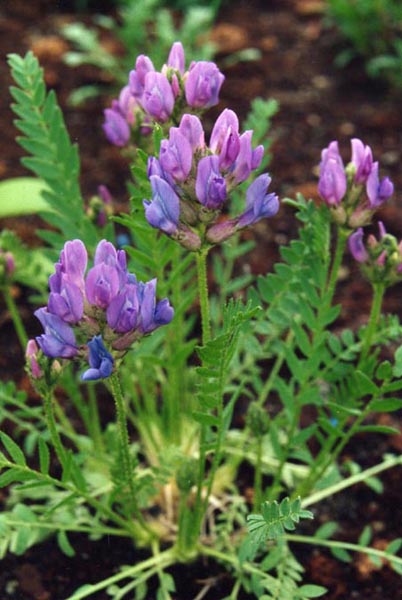
It forms low, upright clumps, about 15 to 25 cm in height. The leaves are pinnate, with elongated leaflets of a fairly bright green, without the silvery coating characteristic of other Oxytropis; the viscida variety is precisely distinguished by the presence of sticky glandular hairs on the stems and calyces, giving it a slightly sticky feel to the touch.
The papilionaceous flowers are a fairly bright blue-violet to lilac, gathered in dense, rounded heads carried by sturdy peduncles. The color variation between the still pinkish-mauve buds and the fully bloomed blue-violet flowers is particularly noticeable and gives the inflorescences a pleasing bicolored appearance.
In its natural habitat, it blooms from June to August.
Like the entire genus, it requires impeccable drainage, a poor and mineral soil, in full sun. Its deep taproot makes any transplantation delicate; sowing in deep pots remains the safest way.