syn. Oxalis lobata
syn. Oxalis lobata
Bulbous perennial of the Oxalidaceae family, native to central Chile, where it grows in dry lawns, rocky slopes, and open environments at moderate altitude, under a climate with hot, dry summers and cool winters.
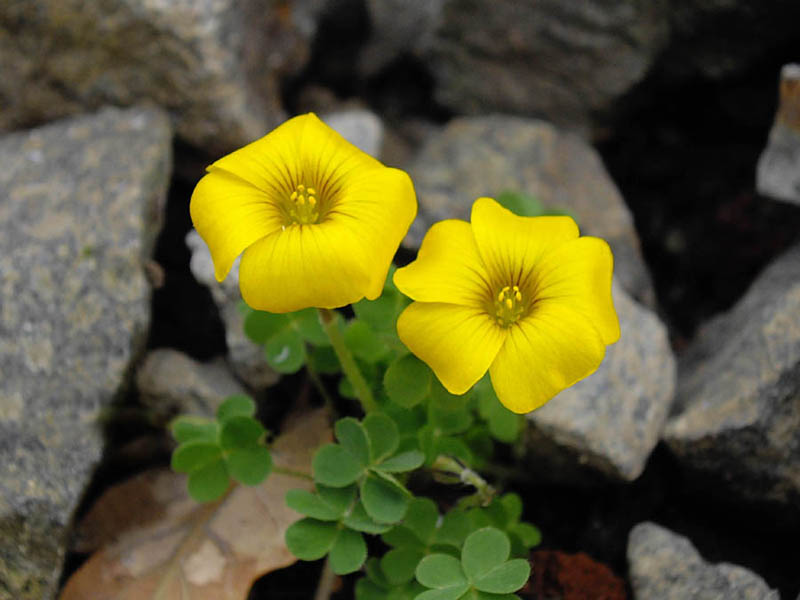
It forms very small, low clumps, barely 5 to 8 cm, with trifoliate foliage with rounded and slightly notched leaflets, a bright and shiny green. As with Oxalis obtusa, the disproportion between the small foliage and the flowers is striking, but here it is expressed differently: the widely open corollas, a bright and pure yellow, seem to be placed directly on the carpet of small leaves, with a luminous presence that their size does not suggest.
The flowers have a central brown-reddish to dark burgundy eye, from which fine veins radiate on each petal, creating a striking contrast with the intense yellow of the limb. This dark star pattern in the center is one of the most immediately recognizable features of the species.
In its natural habitat, its flowering extends from April to June (southern autumn). In cultivation under our latitudes, it blooms in autumn, from September to November.
It is cultivated in pots or very well-drained rock gardens, in full sun, with a dry summer rest respected. Its hardiness is moderate and protection against prolonged frosts is recommended. Cultivation in a container under a cold, bright shelter gives excellent results.