Bulbous perennial from the Oxalidaceae family, native to the Cape in South Africa, where it grows in fynbos, rocky slopes, and well-drained sandy soils, under a Mediterranean climate with dry summers and mild, rainy winters.
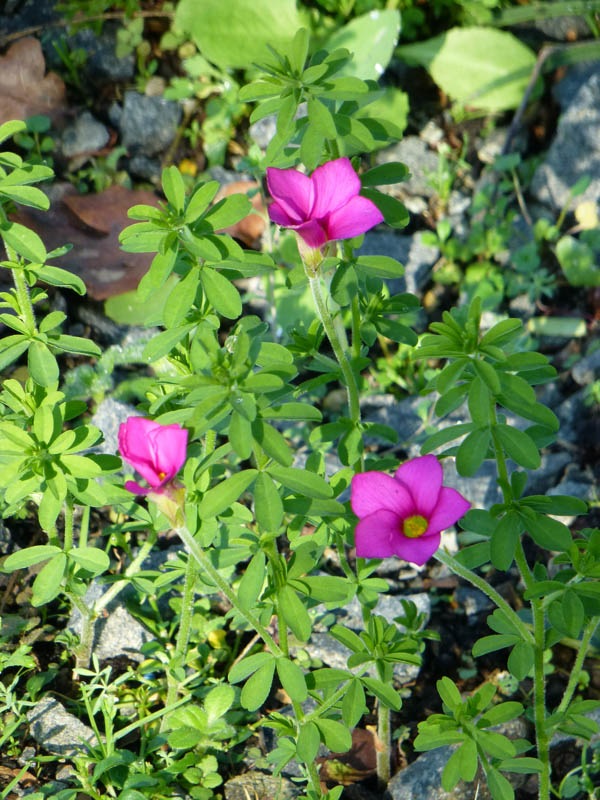
It develops upright to slightly drooping stems of 15 to 25 cm, covered with fine, visible hairs — a characteristic directly evoked by the epithet hirta. The leaves, trifoliate, with obovate leaflets of a bright green, are arranged in whorls along the stems, giving the plant an airy and branched silhouette, quite different from the low tufted habit of the Andean species of the genus.
The flowers, solitary in the axils of the upper leaves, are a magenta to bright pink with a well-marked central yellow eye. They are large for the genus, very bright, and open generously in sunny weather. The flowering is abundant and renews over several weeks.
In its natural habitat, its flowering extends from April to July (austral autumn-winter). In cultivation in our latitudes, it blooms in autumn, from September to November.
It is cultivated in pots or in very well-drained rockeries, in full sun, brought indoors to protect from frost in winter under cold climates. The bulb enters summer dormancy and must remain dry during this period. Its hardiness is low beyond a few degrees of frost.