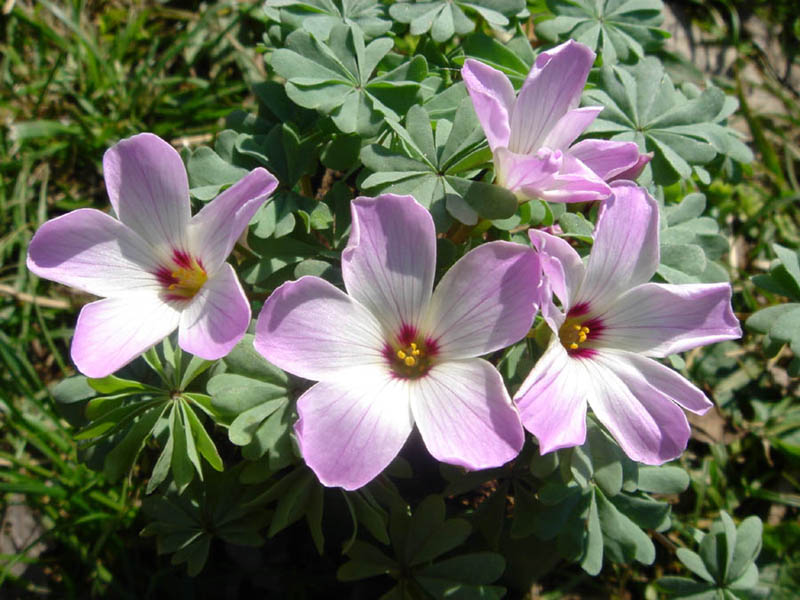
Bulbous perennial of the Oxalidaceae family, native to the Andes of Chile and Argentina, where it grows on scree and rocky slopes at altitude, in conditions of high luminosity, cold and dry winters, and relatively cool summers.
It forms small compact clumps of 5 to 8 cm, consisting of numerous palmate leaves with multiple leaflets, of a characteristic glaucous gray-green, with a slightly fleshy texture. Each leaf is composed of 9 to 22 fan-shaped leaflets, folded at night and in cloudy weather — a nyctinastic behavior typical of the genus. The bulb, covered with interwoven fibers, is a distinctive feature of the species.
The flowers, borne individually on short peduncles, are large for the size of the plant, pink to pale lilac with more pronounced veins and a deep crimson central eye bordered with white, giving them a vivid and precise appearance. They bloom abundantly in spring.
In its natural habitat, its flowering extends from November to January (austral summer). In cultivation in our latitudes, it blooms from April to May.
It is cultivated in very well-drained rock gardens or in pots, in full sun, in a poor mineral substrate. It tolerates moderate frosts provided the soil is dry in winter. Stagnant moisture during dormancy is unfavorable to it.