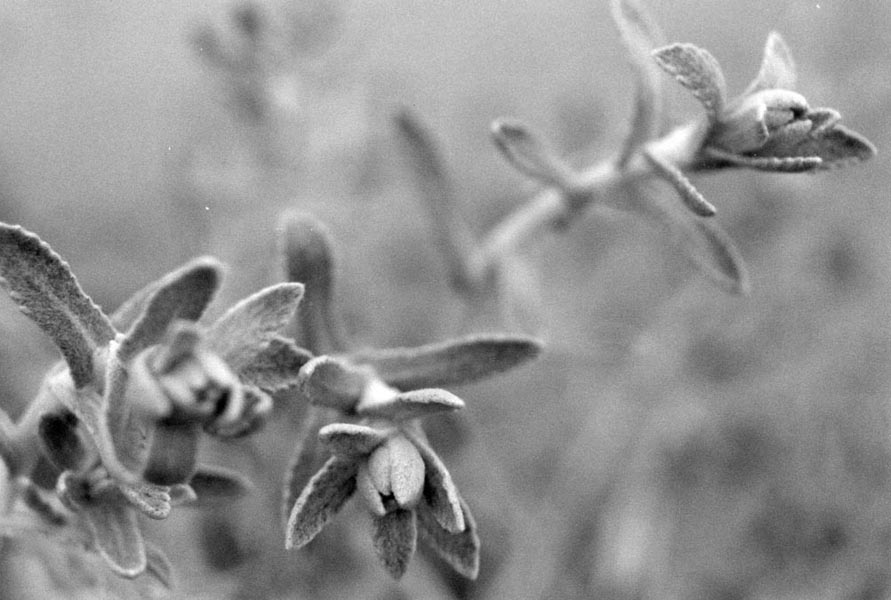
Shrubby perennial of the Asteraceae family, found on the Atlantic and Mediterranean coasts of Europe, from Portugal to the Black Sea. It exclusively colonizes mobile and semi-fixed coastal dunes, directly exposed to wind and sea spray, on dry and poor sands.
It forms spreading and branched clumps 20 to 40 cm in height, entirely covered with a dense, cottony white tomentum that envelops stems, leaves, and floral involucres. The leaves are small, thick, lobed to crenate, closely packed along the branches, with a uniform silvery white. Before anthesis, the capitula resemble small, perfectly spherical white cotton balls, arranged in terminal clusters—a striking spectacle up close. At blooming, the bright yellow tubular flowers emerge from this woolly involucre, creating a sharp contrast between the yellow of the flowers and the white of the foliage.
In its natural habitat, its flowering extends from July to September.
Protected species in several countries due to the regression of coastal dunes, it is rarely cultivated. In gardens, it requires a perfectly drained sandy soil, full sun, and a windy exposure; it does not tolerate stagnant winter moisture. Its hardiness in cold and humid climates remains limited.