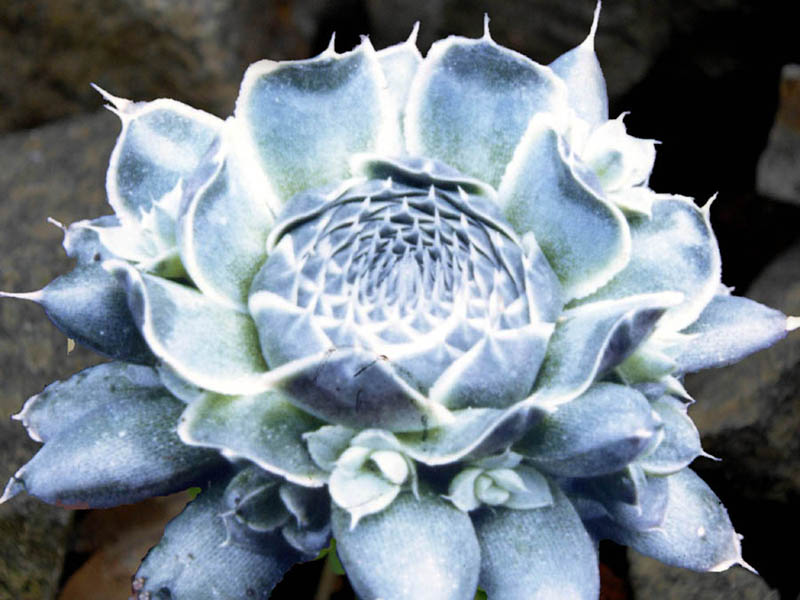
A monocarpic perennial from the Crassulaceae family, native to Central Asia and Siberia, where it grows on rocks, stabilized screes, cliffs, and very well-drained stony slopes, often at altitude and under extreme climatic conditions, alternating dry summers and very cold winters.
It forms dense and perfectly symmetrical rosettes, with a very pronounced blue-gray to glaucous hue, covered with a light bloom, giving them an almost mineral appearance. The fleshy, thick leaves end in a rigid whitish spinescent tip — a characteristic that gives the species its name and immediately distinguishes it from other Orostachys. The center of the rosette exhibits a tightly spiraled architecture of remarkable precision.
Like all Orostachys, the plant is monocarpic: after several years of vegetative growth, it produces an erect floral stem bearing a dense spike of small whitish-yellow to pinkish flowers, then dies. It perpetuates itself through daughter rosettes produced at the base before flowering.
In its natural habitat, its flowering extends from July to September.
It is cultivated in very well-drained rock gardens or in pots, sheltered from excessive winter humidity which is more harmful to it than cold. It requires full sun and a poor mineral substrate. It is one of the hardiest succulents, tolerating very negative temperatures provided the soil is dry.