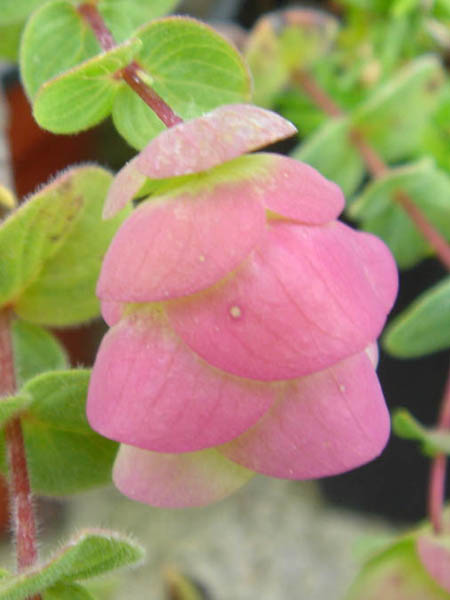
Perennial from the Lamiaceae family, this cultivar is a horticultural hybrid derived from Origanum rotundifolium, a species native to Turkey and Georgia where it grows on limestone rocks and rocky slopes at altitude. The cultivar was selected in the United Kingdom and is named after a renowned British rock garden plant gardener.
It forms a small cascading bush of 20 to 30 cm, with arched stems bearing round to oval leaves, a fresh and slightly glaucous green, sessile and opposite, giving them a characteristic arrangement along the stems.
The inflorescence is spectacular at the plant's scale: large rounded, swollen, and overlapping bracts, first pale green then gradually tinged with deep pink to bright salmon-pink, assemble into hanging spikes that irresistibly evoke small stacked lanterns. Tiny pale lilac-pink tubular flowers escape between the bracts. The contrast between the tender green of the young bracts and the intense pink of the mature bracts on the same stem is one of the most remarkable effects of the genus.
In its natural habitat, the parent species blooms from July to September. In cultivation, 'Barbara Tingey' blooms from June to August.
It requires perfect drainage, a mineral substrate in full sun, and protection from stagnant winter moisture. Cultivation in a pot or raised container, under cold shelter in regions with rainy winters, remains the most reliable solution.