A perennial of the Lamiaceae family, native to Lebanon and the adjacent mountainous regions of Syria and southern Turkey, where it occupies limestone rocks, rocky slopes, and cliffs in sunny exposure.
It forms a small, loose, and cascading bush, 20 to 30 cm in height, with slender, arched stems that naturally extend downward, making it particularly suited to walls, rock garden edges, and raised containers. The leaves are small, oval-rounded, medium green to glaucous, slightly fleshy.
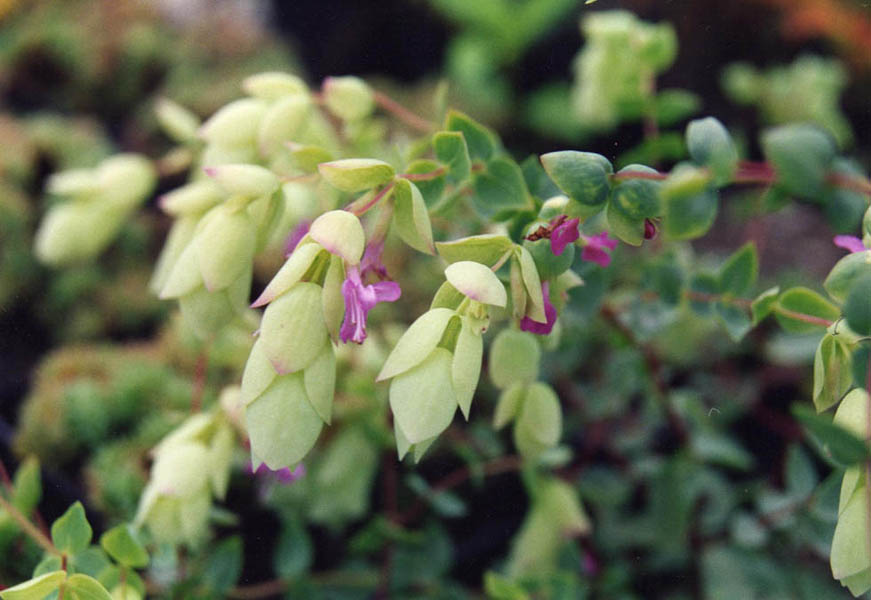
Its most striking feature lies in its bracts, which are wide, swollen, and translucent, pale green to very light yellow-green, almost papery at maturity, arranged in drooping spikes that evoke small lanterns hanging along the arched stems. From these bracts emerge tiny bright rose-purple tubular flowers, whose color contrasts intensely against the pale, luminous background of the bracts.
In its natural habitat, its flowering extends from July to September. In cultivation, it blooms from June to August, sometimes earlier depending on exposure.
It requires a very well-drained, mineral soil in full sun, with protection against excessive winter moisture. Its hardiness is limited, and cultivation under cold shelter or in pots remains prudent in cold and wet climates. It is part of several ornamental hybrids appreciated by oregano collectors.