Perennial of the Lamiaceae family, endemic to the island of Crete, where it naturally grows on limestone cliffs, steep rocks, and arid stony slopes, often at altitudes between 300 and 1,500 meters. It is one of the most emblematic plants of the Cretan flora.
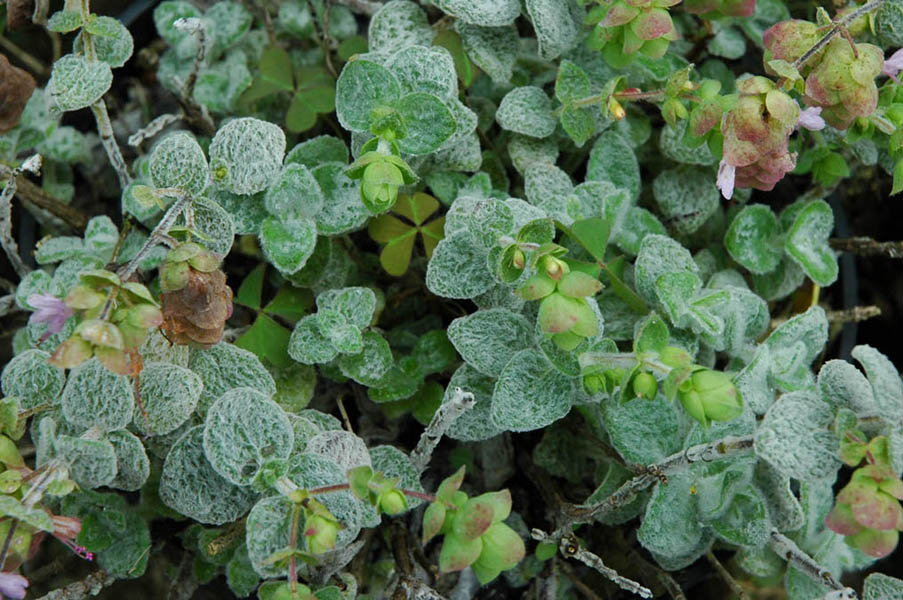
It forms a small loose and cascading bush, 15 to 30 cm in height, with slender and branched stems that naturally arch. The foliage is its first visible attraction from a distance: the leaves are round to oval, thick, entirely covered with a very dense white-woolly tomentum that gives them an almost cottony appearance. This abundant pubescence, which also concerns the stems and young bracts, constitutes a remarkable adaptation to the drought and intense sunlight of its natural habitat.
The inflorescences bear small pink to pink-purple bracts that frame tiny bright pink to purple tubular flowers, producing a delicate contrast with the silvery-gray foliage. In its natural environment, its flowering extends from July to September. In cultivation, it blooms from June to August.
Known since Antiquity for its medicinal virtues, it was harvested on the inaccessible cliffs of Crete, which earned it an almost mythical reputation; Aristotle and Dioscorides mentioned its use.
It requires perfect drainage, a poor mineral substrate, in full sun, and rigorous protection against winter humidity. Pot cultivation under cold shelter is strongly recommended in rainy climates.