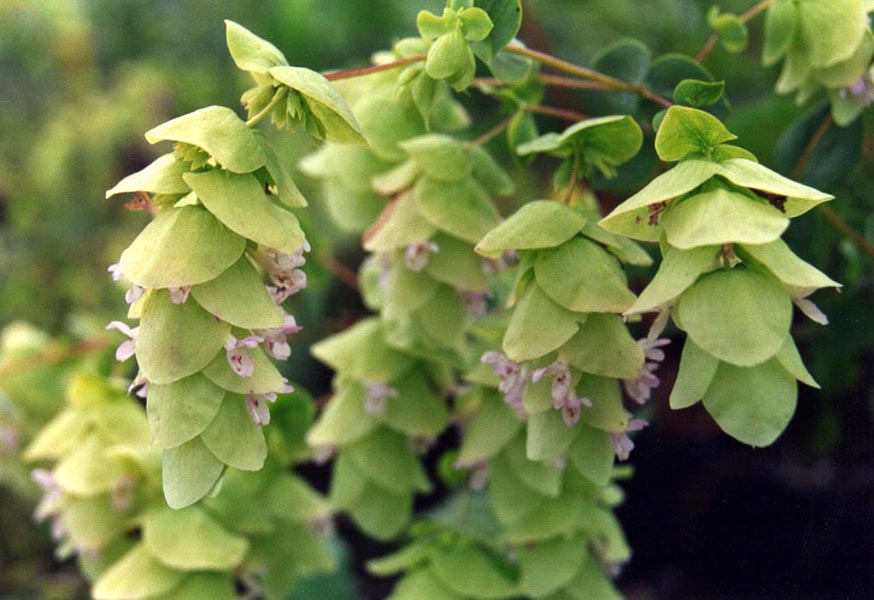
Perennial of the Lamiaceae family, endemic to Turkey, where it occupies limestone rocks, dry rocky slopes, and sunny cliffs, mainly in the mountainous regions of Anatolia.
It forms a loose, branched bush 20 to 30 cm in height, with woody stems at the base and drooping in cultivation, making it a natural candidate for walls, rock garden edges, or raised containers. The leaves are small, oval-rounded, medium green, slightly leathery.
The most immediately striking feature of this species is the structure of its inflorescences. The bracts, large, oval, chartreuse green to yellowish green, overlap in hanging, interlocking spikes that irresistibly evoke hop cones. The small tubular flowers, pale pink to whitish, discreetly emerge between these persistent bracts, but it is the color and shape of the latter that dominate the whole and give the plant its very particular appearance.
In its natural habitat, its flowering extends from July to September. In cultivation, it blooms from June to August depending on the exposure.
It requires well-drained soil, calcareous or neutral, poor, in full sun, and withstands summer drought well once established. It resists cold properly provided there is impeccable drainage, but may suffer from prolonged wet winters. The aromatic fragrance of the crushed foliage is reminiscent of Mediterranean oreganos.