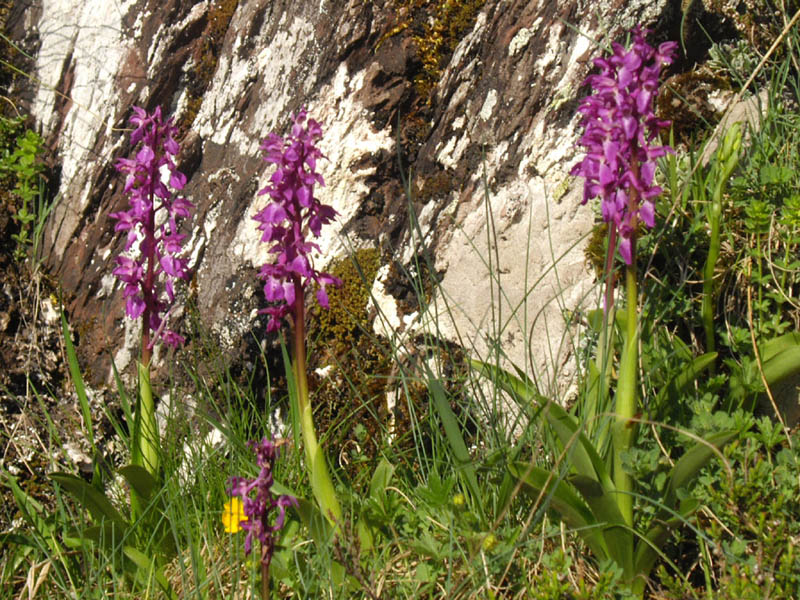
photographed in the Pyrenees
photographed in the Pyrenees
Early-purple orchid. Tuberous perennial of the Orchidaceae family, widely distributed in Europe, from the Iberian Peninsula to southern Scandinavia and east to the Caucasus. In France, it is present in a large part of the territory, from plains to mountainous areas, up to about 2,000 meters in the Alps and the Pyrenees.
It grows in poor meadows, calcareous grasslands, clearings and forest edges, exposed hillsides and high-altitude pastures. It favors calcareous to neutral, well-drained soils, and tolerates both full sun and light shade.
The stem is erect, 20 to 50 cm in height, bearing at its base a rosette of oblong to lanceolate leaves, a shiny green often marked with characteristic brown-purple spots. The floral spike is dense, cylindrical, composed of numerous bright pink-purple to magenta flowers. Each flower has a trilobed labellum spotted with dark purple in the center, and a nectariferous spur curved upwards — although the plant does not produce nectar and deceives its pollinators through olfactory mimicry.
In its natural habitat, its flowering extends from April to June depending on altitude and exposure. It is one of the first European orchids to bloom in spring, which contributes to its particular appeal in the still sparsely colored landscapes of early season.
Like all native orchids, it lives in symbiosis with specific mycorrhizal fungi and does not grow in ordinary rock gardens; it sometimes naturalizes in unfertilized poor meadows maintained by late mowing.