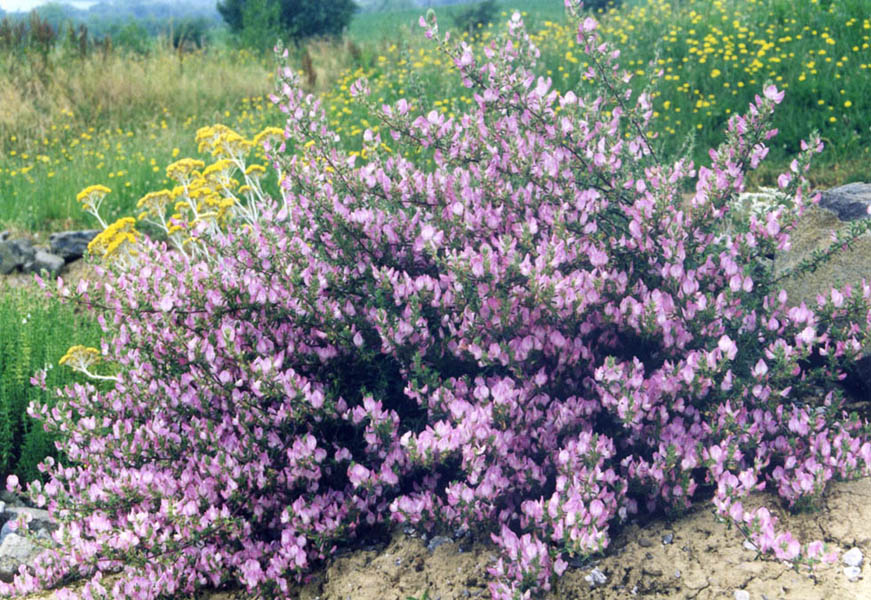
Subshrub of the Fabaceae family, widely spread in Europe, from the Iberian Peninsula to Central Asia, also present in North Africa. It occupies dry grasslands, roadsides, calcareous slopes, wastelands, and degraded pastures, from sea level to mid-altitude.
It forms rounded and dense bushes, heavily branched, armed with sturdy spines resulting from the transformation of branches, reaching 40 to 60 cm in height. The woody stems at the base bear two rows of characteristic hairs. The leaves are trifoliate, with oval and toothed leaflets, medium green, pubescent and slightly sticky.
The papilionaceous flowers are lilac pink to bright pink, with fine darker veins on the standard. They are produced abundantly over the entire bush, giving it a very ornamental appearance at the time of flowering, almost improbable for such a common plant. In its natural habitat, its flowering extends from June to September.
The plant has been used in traditional phytotherapy, notably as a diuretic; its roots were listed in ancient European pharmacopoeias. Its thorny nature also made it a rustic fencing plant in rural areas.
In cultivation, it accepts any well-drained soil, calcareous or neutral, in full sun. Robust and xerophilous, it is suitable for dry slopes, large rock gardens, and natural gardens.