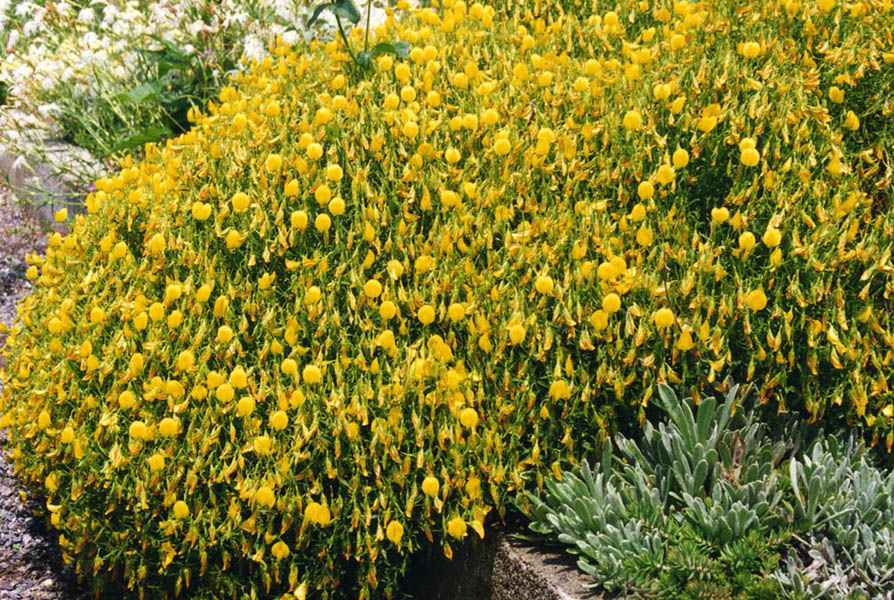
Sub-shrub of the Fabaceae family, widespread in the western Mediterranean basin, from southern France and the Iberian Peninsula to Italy and North Africa. It inhabits limestone garrigues, dry grasslands, stabilized screes, and sunny rockeries at low and medium altitudes.
It forms very dense and compact hemispherical clumps, reaching 20 to 40 cm in height, with slender and highly branched stems, giving it a particularly clear rounded dome shape. The leaves are small, simple or trifoliate depending on the stems, medium green, slightly pubescent and sticky.
The papilionaceous flowers are bright and vivid yellow, small but produced in exceptional quantity over the entire clump, almost entirely covering it with a uniform color mantle at the peak of flowering. It is this remarkable floral density, forming an almost solid luminous cushion, that is the most striking feature of the species in cultivation. In its natural habitat, its flowering extends from May to July.
In cultivation, it requires a calcareous or neutral soil, very well-drained, poor, in full sun exposure. Robust and drought-resistant once established, it tolerates neither stagnant moisture nor heavy soils. It is perfectly suited to large sunny rockeries and Mediterranean gravel gardens.