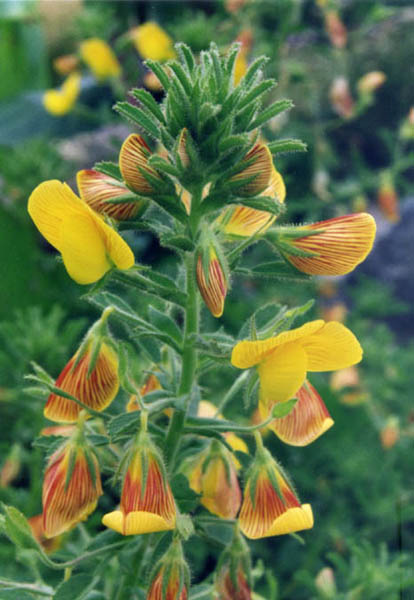
It forms bushy clumps, upright to spreading, reaching 20 to 50 cm in height, with viscous and glandular-pubescent stems, very sticky to the touch, which gives it its epithet and common name. The leaves are trifoliate, with small, oval, toothed leaflets, of medium green, also glandular.
The papilionaceous flowers are one of the most unique ornaments of the genus in the Mediterranean flora. The standard is bright and plain yellow, while the wings bear fine red-orange to reddish-brown streaks very marked on a pale yellow background, creating a particularly striking veined and contrasting effect up close. The still-closed flower buds, entirely streaked with red, accentuate this decorative effect. In its natural habitat, its flowering extends from April to July depending on exposure.
In cultivation, it requires a calcareous or neutral soil, very well-drained, poor, in full sun exposure. Resistant to summer drought, it does not tolerate stagnant humidity or compact soils. It is suitable for Mediterranean rockeries and sunny gravel gardens.