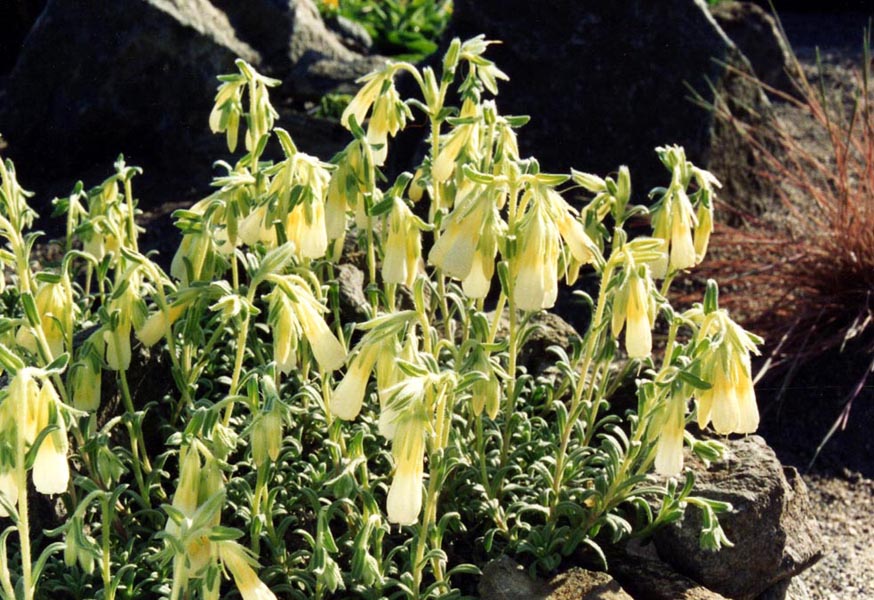
A perennial of the Boraginaceae family, native to the mountainous regions of the Near East and Asia Minor, mainly from Lebanon, Syria, and southern Turkey. It colonizes rocks, screes, and dry rocky slopes in sunny exposure.
It forms low and compact tufts, 10 to 20 cm in height excluding flowering, from which numerous slender and upright flowering stems rise, giving it, at the time of flowering, a very recognizable airy and bustling appearance. The leaves are narrowly linear to lanceolate, medium green to gray-green, with a covering of short hairs that gives them a slightly rough texture without reaching the silvery character of other species of the genus.
The flowers are tubular, distinctly drooping, from creamy white to very soft pale yellow, slightly greenish at the base of the tube, gathered in scorpioid cymes at the end of the stems. Their abundance at full bloom is striking, the stems literally covered with these small delicate hanging bells. In its natural habitat, its flowering extends from May to July; in cultivation, it often occurs as early as April-May.
It requires perfect drainage, poor, calcareous or neutral soil, in full sun. Like most Onosma, it suffers from stagnant winter humidity; light protection or pot cultivation under a cold shelter may be useful in humid Atlantic climates.