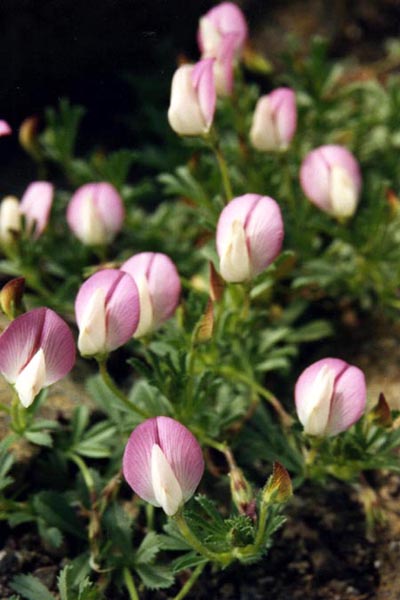
Perennial of the Fabaceae family, endemic to the western Alps, mainly known from the Franco-Italian massifs around Mont-Cenis and a few adjacent areas. It occupies fine scree, rocky outcrops, and stony alpine lawns, on siliceous or mixed substrates, generally between 1,800 and 2,800 meters.
It forms small, low, compact tufts, slightly bushy, reaching 5 to 10 cm in height. The leaves are trifoliate, with small, oval, toothed leaflets, of medium green, slightly sticky and pubescent to the touch, a common characteristic in the genus Ononis.
The papilionaceous flowers are remarkably large compared to the size of the plant. The standard is lilac pink to mauve pink, streaked with darker veins, contrasting with the whitish to cream keel that points between the wings. This delicate bicolored effect, almost pearly, gives the flowers a particularly elegant appearance. In its natural environment, its flowering extends from July to August.
In cultivation, it requires a very well-drained, poor soil, in full sun exposure, with protection against stagnant winter moisture. It is grown in rock gardens or alpine troughs and deserves to be better known by enthusiasts of demanding mountain plants.