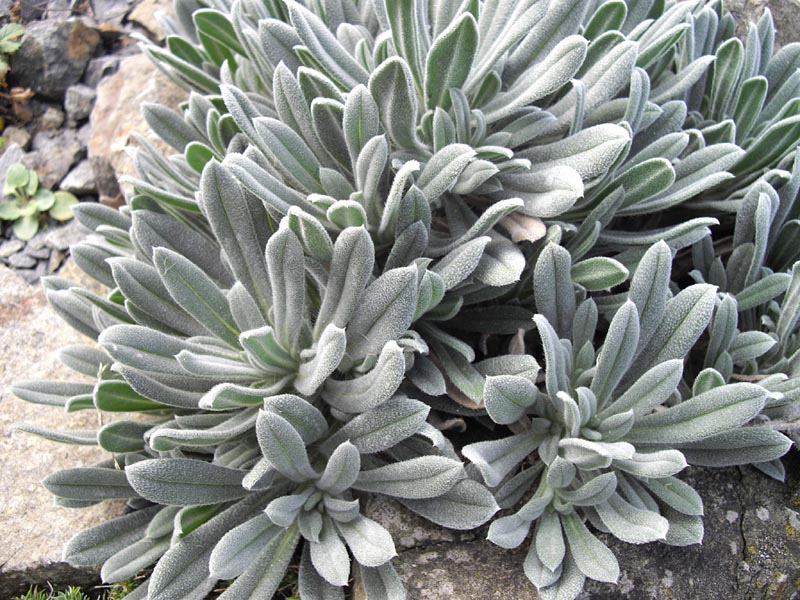
Perennial of the Boraginaceae family, native to Asia Minor, mainly Turkey. It occupies calcareous rocks, stabilized scree, and dry stony slopes in full exposure, at varying altitudes depending on the massifs.
It forms dense, rounded clumps, 20 to 30 cm in height, with erect or slightly ascending stems. The foliage is one of the most immediately remarkable elements of the species outside of flowering: the leaves are narrowly lanceolate, covered with a dense indumentum of whitish hairs that give them a very pronounced silvery-gray hue, almost woolly, with great graphic clarity on the rockery.
The flowers are tubular, pendulous, gathered in scorpioid cymes coiled at the end of the stems according to the typical arrangement of Boraginaceae. Their color evolves during flowering, changing from bright pink to coral red in bud, then gradually fading to creamy white at maturity; this simultaneous variation of shades on the same branch is the most distinctive and appealing feature of the species. In its natural habitat, its flowering extends from May to July; in cultivation, it can begin as early as the end of April.
It requires calcareous or neutral soil, very well-drained, in full sun, and poorly tolerates prolonged winter humidity. A position on a slope or in a wall fissure suits it perfectly. It adapts well to pot culture under cold shelter to protect it from excess moisture.