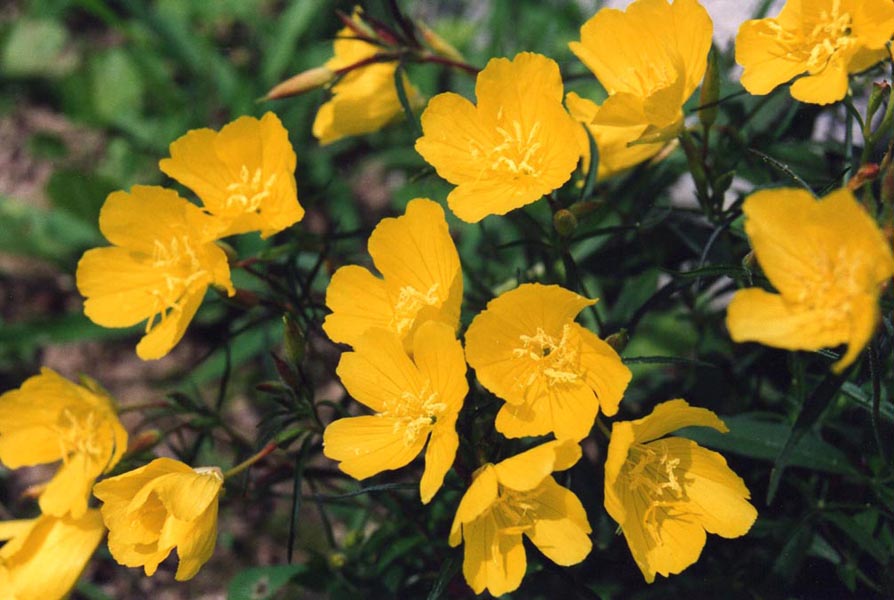
The plant forms upright and branched clumps reaching 40 to 60 cm in height. The reddish stems bear lanceolate, alternate, slightly toothed leaves, dark green often tinged with bronze or purple, especially at the beginning and end of the season. This coppery foliage coloration is one of the most distinctive signs of the species.
The flowers are large, with four bright yellow, slightly notched petals, gathered in loose terminal clusters. They open during the day, unlike many of their nocturnal cousins of the genus. In its natural habitat, its flowering extends from May to July. In cultivation, it generally occurs from June to August depending on the climate.
It does not present any documented and recognized medicinal or food uses for this specific species, to be distinguished from Oenothera biennis whose seeds are industrially exploited.
In cultivation, it appreciates a sunny location, well-drained soil, rather poor to moderately fertile. It tolerates drought once established and is suitable for perennial beds, borders, and gravel gardens with a natural ambiance.