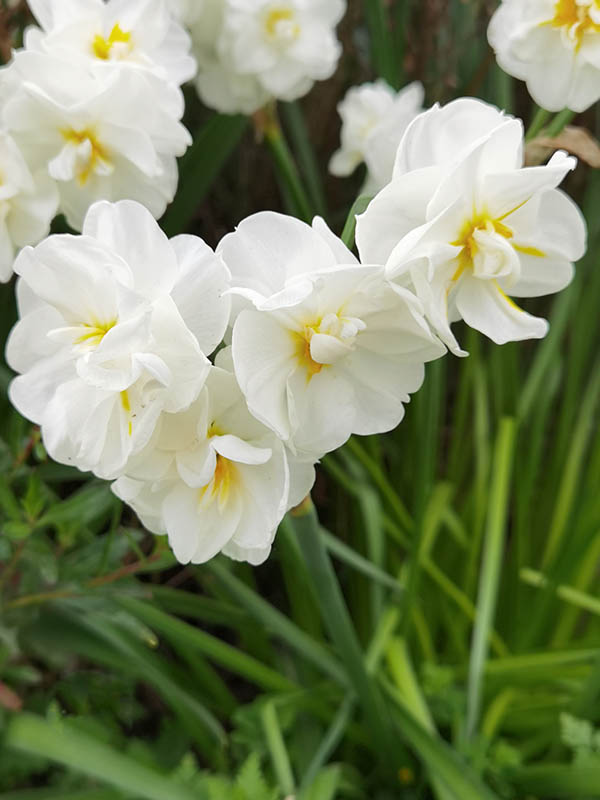
Amaryllidaceae. Horticultural cultivar of the Double group, close or related to the cultivar 'White Cheerfulness', itself selected from 'Cheerfulness', obtained in the Netherlands at the beginning of the 20th century. The precise identification of this specimen could not be confirmed with certainty.
The plant reaches 35 to 45 cm in height. The leaves are upright, ribbon-like, dark green. Each stem bears two to three flowers, a multifloral characteristic typical of the tazetta lineage from which these cultivars originate. The flowers are fully double, pure white, with a heart composed of interlocking petaloids tinged with bright golden yellow, clearly visible at the center of each flower. This contrast between the whiteness of the outer tepals and the bright yellow of the heart is one of the plant's most striking features.
In cultivation, flowering occurs in April-May, among the late mid-season daffodils. These cultivars are renowned for their pronounced fragrance, inherited from their tazetta-affinity ancestors.
It is grown in well-drained ordinary soil, in full sun or light partial shade. Robust and perennial, it multiplies by dividing clumps every three to four years. It is suitable for both open ground and container cultivation.