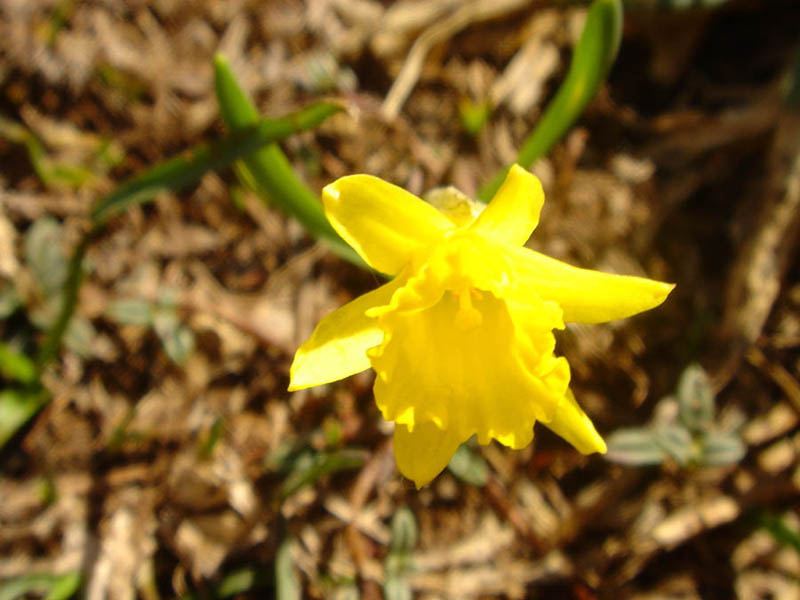
photographed in the Picos de Europa
photographed in the Picos de Europa
Amaryllidaceae. Small bulbous perennial daffodil endemic to the Aragonese Pyrenees and the Jaca region in northern Spain. This subspecies is distinguished from the type species, cantabric, by its eastern distribution area and some subtle morphological characteristics. It colonizes dry to semi-dry grasslands, rocky areas, and stabilized screes on limestone substrate, between approximately 800 and 1,600 meters.
The plant is remarkably dwarf, rarely exceeding 8 to 12 cm in height, and bears a single flower per stem — a constant and diagnostic feature of the asturiensis group. This flower, entirely bright yellow, has a well-developed trumpet, distinctly tubular and lobed at its edge, surrounded by reflexed to spreading tepals, slightly shorter than the corona. The foliage is narrow, glaucous, upright, appearing at the same time as the flowers or slightly before.
In its natural habitat, its flowering extends from February to April depending on altitude and exposure, often as soon as the snow melts.
In cultivation, it blooms early in the season, sometimes as early as January-February under cold shelter. It requires perfect drainage, a sunny exposure, and a dry summer rest respected. Suitable for limestone rock gardens, alpine troughs, and troughs.