Perennial of the Boraginaceae family, Myosotis pulvinaris is endemic to New Zealand, where it is found in the alpine and subalpine zones of the South Island, on rocky substrates, scree, and high-altitude grasslands exposed to severe climatic conditions.
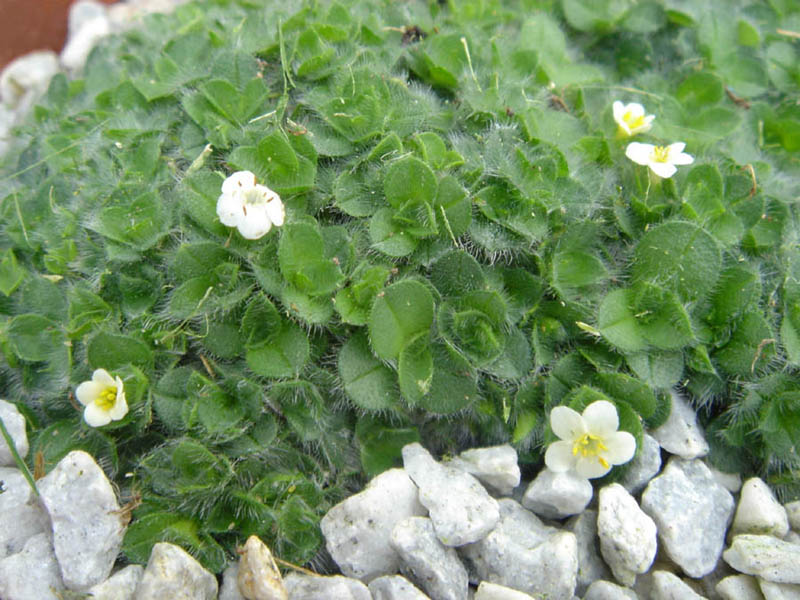
It forms a dense, tight, and rounded cushion, hardly exceeding 3 to 5 cm in height, but can spread over several centimeters in diameter over time. The leaves are very small, oval to spatulate, of a deep green, entirely covered with long, stiff, shiny white hairs that give them a very particular bristly appearance, almost silvery in certain lights. This dense hairiness is an adaptation to harsh alpine conditions.
The flowers, borne at the cushion's surface, are tiny, with five rounded petals, pure white with a central yellow-green eye, set like small jewels on the carpet of hairy foliage.
In its natural habitat, its flowering extends from December to February (austral summer). In cultivation under the temperate climate of the northern hemisphere, it generally blooms in spring.
It is a demanding plant, reserved for cultivation in a cold greenhouse or alpine trough. It requires perfect drainage, protection against excessive winter humidity, and a poor mineral substrate. The collar is particularly sensitive to rot.