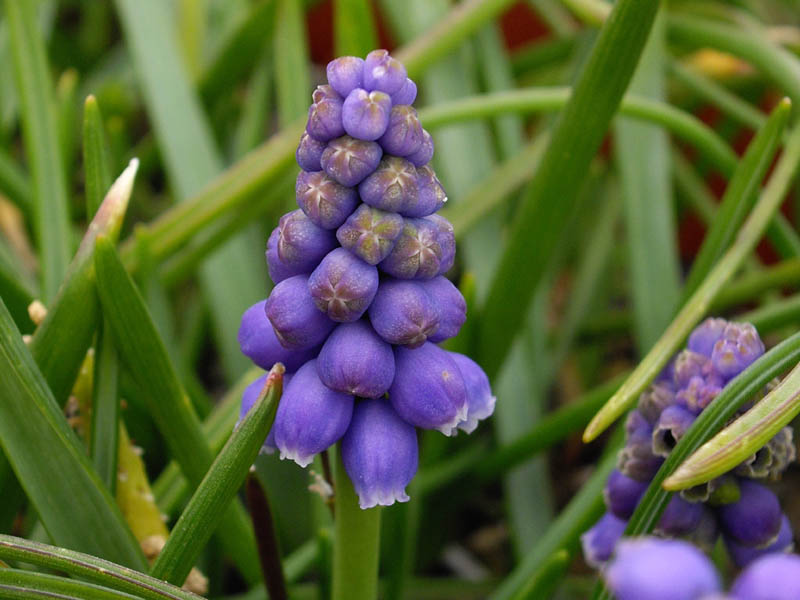
A perennial bulbous plant from the Asparagaceae family, Muscari armeniacum is native to the Caucasus, Turkey, and the Balkans, where it colonizes meadows, open scrublands, roadsides, and edges, from sea level to mountainous areas.
It reaches 15 cm in height. The leaves are linear, narrow, medium green, and often appear as early as autumn to overwinter in vegetation, distinguishing it from several other species of the genus. The floral spikes, dense and compact, bear numerous small tubular to urn-shaped flowers, of a deep violet-blue, edged with a white border at the opening; the upper, sterile flowers are slightly paler and smaller, giving the spike its characteristic two-tone appearance.
In its natural habitat, flowering extends from March to May. In cultivation under a temperate climate, it generally blooms from April to May.
Very accommodating, it easily naturalizes and multiplies by bulbils to quickly form dense clumps. It is suitable for rock gardens as well as flowering lawns, at the base of shrubs, and borders. It tolerates most well-drained soils, in sun or partial shade, and requires virtually no maintenance.