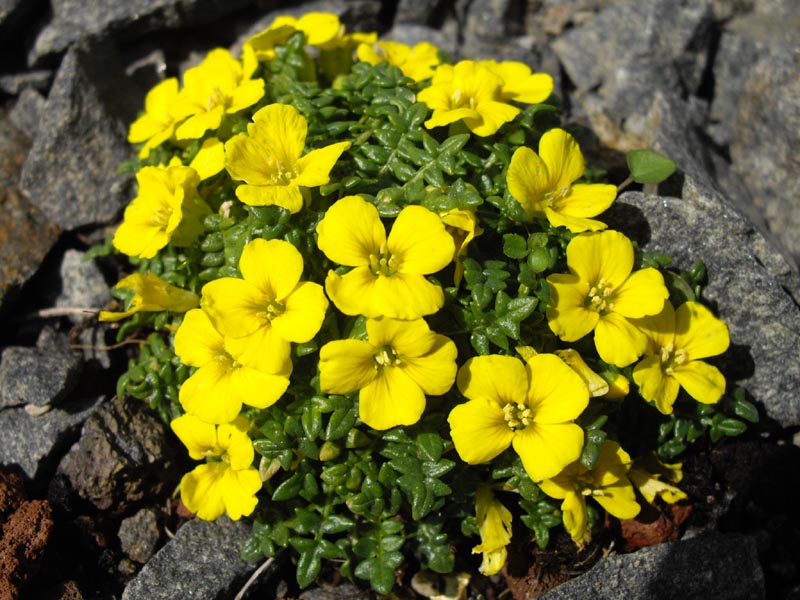
Perennial of the Brassicaceae family, Morisia monanthos is an endemic species of Corsica and Sardinia, where it grows in coastal sands and dune areas, but also in certain sectors of open garrigue and sandy substrates inland.
It forms a flattened, strictly stemless rosette, barely exceeding 3 to 5 cm in height. The leaves are deeply pinnatifid, a glossy dark green, with a slightly leathery texture, arranged in a tight and dense rosette that spreads flat on the ground. This absolutely prostrate habit is one of the most striking characteristics of the monotypic genus.
The flowers, borne individually on very short peduncles almost sessile at the heart of the rosette, have four bright and luminous yellow petals, typical of the Brassicaceae. They emerge in such great numbers that they completely mask the foliage at the peak of flowering. In its natural habitat, flowering extends from March to May; in cultivation under temperate climates, it generally occurs from March to April.
It requires a very well-drained, sandy or gravelly soil, and a sunny exposure. Unlike many Mediterranean rock garden plants, it is accommodating in cultivation and poses no particular difficulties, provided water stagnation at the collar is avoided in winter. It is easily cultivated in full rock garden as well as in troughs.