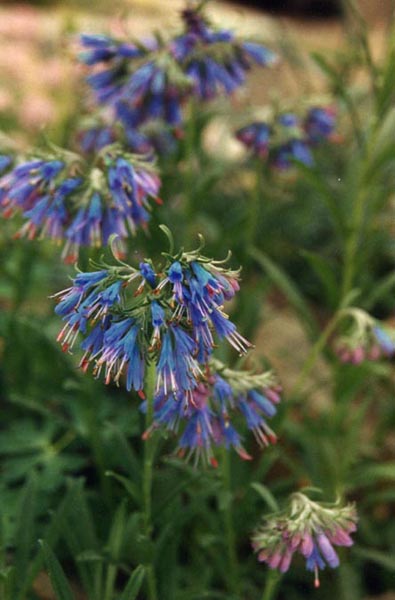
A perennial of the Boraginaceae family, Moltkia petraea is native to the Balkans — Albania, former Yugoslavia, northern Greece — where it grows on limestone rocks, screes, and very sunny rocky slopes, in open and arid environments.
It forms a dense and branched bush, 20 to 25 cm in height, with woody stems at the base. The leaves are narrow, linear to linear-lanceolate, dark green on top, whitish and finely hairy underneath, tightly arranged along the stems. This compact bushy habit, carpeted with flowers at full anthesis, is one of the most immediately recognizable traits of the species in rock gardens.
The flowers are tubular, grouped in terminal scorpioid cymes characteristic of the Boraginaceae. Their color changes very markedly during flowering, from lilac-pink to purplish at the bud stage, then gradually turning to bright blue to blue-violet at full opening. The dark, exserted stamens enhance the ornamental character of the inflorescences.
In its natural habitat, its flowering extends from May to July. In cultivation, it generally occurs in June.
It is cultivated in full sun, in a very well-drained and rather poor limestone substrate, sheltered from any stagnant moisture in winter. Drought-tolerant once established, it is perfectly suited to rock gardens, walls, and alpine gardens.