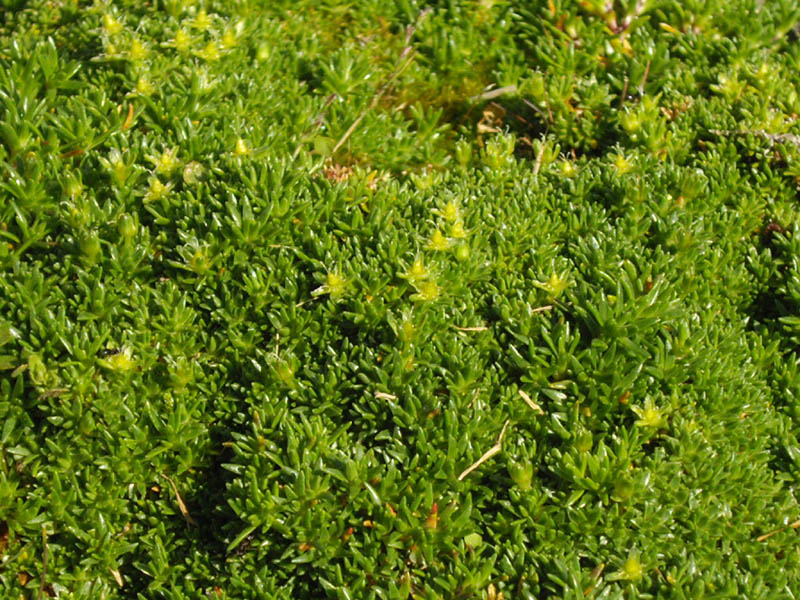
Perennial of the Caryophyllaceae family, this miniature form is related to Minuartia stellata, a species native to the mountains of the Balkan Peninsula and Greece, where it occupies limestone rocks, crevices, and stony lawns at altitude, in full sun exposure.
The minima form is distinguished by a particularly compact and tight cushion, only 2 to 4 cm in height, with a finely granular surface. The leaves are very short, oval to slightly spatulate, arranged in tiny star-shaped rosettes that closely interlock to form a mass of medium to dark green, speckled with lighter highlights at the tips of growing shoots. The center of the cushion, older, takes on a brown hue characteristic of Minuartia in dense cushions over time.
The flowers are very small, with five petals, of a greenish-white to cream-green, blending almost into the foliage to the point of being barely noticeable. In its natural habitat, flowering extends from May to July.
It is cultivated in full sun, in a very well-drained and poor limestone substrate. In a pot or elevated rock garden, it is accommodating and grows slowly without requiring special care, provided stagnant moisture is excluded.