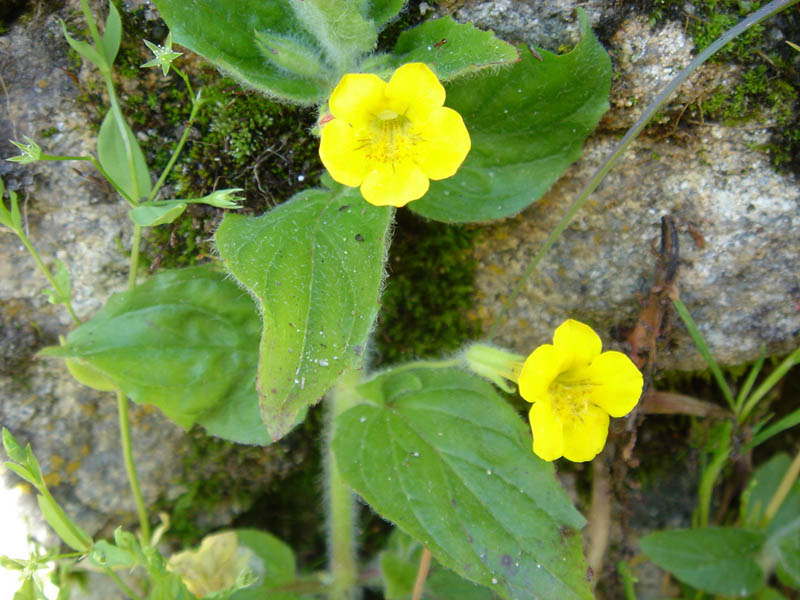
Perennial of the Phrymaceae family, native to the western part of North America, from the mountainous regions of British Columbia to California. Naturalized in Europe, it has established itself sporadically on humid banks and shaded seepages. It colonizes stream banks, springs, and wet rocks, often at altitude.
It forms low and spreading clumps, rarely beyond 15 to 20 cm, with slender, soft, and viscous stems, entirely covered with dense and glandular hairiness that gives it a characteristic sticky touch. The leaves are oval, toothed, of a tender green, also hairy.
The flowers are bilabiate, of a pure and bright yellow, smaller and more open than those of Mimulus guttatus, without spots or speckles in the throat. In its natural habitat, flowering extends from June to August. In cultivation, it can bloom from May to September.
Its name evokes the musky fragrance the plant was reputed to emit, curiously lost in almost all cultivated specimens since the 19th century, a phenomenon rarely observed in a species and remained unexplained. It requires a cool to moist, rich soil, in partial shade. It reseeds spontaneously in conditions that suit it.