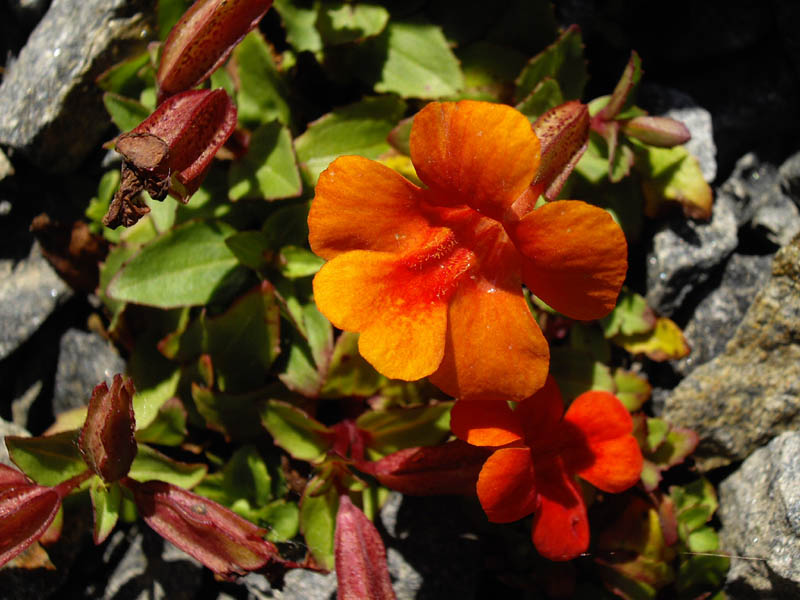
Short perennial of the Phrymaceae family, native to Chile, where it colonizes the banks of mountain streams and moist rocks at altitude. It is often cultivated as an annual or biennial in regions with harsh winters.
It forms low and spreading clumps, 10 to 20 cm in height, with fleshy stems, slightly creeping at the base. The leaves are oval, bright green, slightly toothed, tinged with purple-brown on young shoots and calyces, this contrast between the dark foliage and the flowers being one of the most immediately striking features of the plant. The flowers, widely open in a corolla with five spreading lobes, are of an intense coppery orange, often gradually darker towards the center, with slight copper-red hues depending on the individuals.
In its natural habitat, its flowering extends from November to February in the southern hemisphere. In cultivation under our latitudes, it blooms from June to September.
It requires a constantly fresh to moist soil, rich in humus, and a sunny to semi-shaded exposure. It is suitable for moist rock gardens, the edges of water features, and the interstices of walls kept cool. It is the origin of many horticultural hybrids with varied colors.