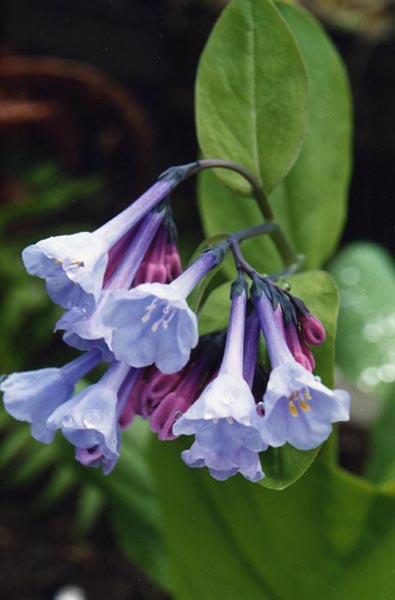
Perennial of the Boraginaceae family, native to the eastern United States, from the Appalachians to the Midwest plains. It grows in alluvial forests, moist undergrowth, and shaded banks, on humus-rich soils, fresh to moist in spring.
It forms upright clumps of 30 to 60 cm, with glaucous and fleshy stems. The leaves are oval, smooth, with a characteristic blue-green color, slightly glaucous as well. The flowers are tubular, drooping, gathered in scorpioid cymes; the buds are pinkish-purple to purple, and open into a bright light lavender blue, the transition between the two shades being one of the most striking aspects of the plant in bloom.
In its natural habitat, its flowering extends from March to May. In cultivation, it blooms from April in temperate regions.
Spring ephemeral plant, it goes into complete dormancy at the beginning of summer: the stems and leaves disappear entirely until the following spring. It requires a fresh, rich, well-drained soil in depth, in shade or partial shade. It naturalizes willingly under deciduous trees, alongside other ground-cover species that will mask its summer disappearance.