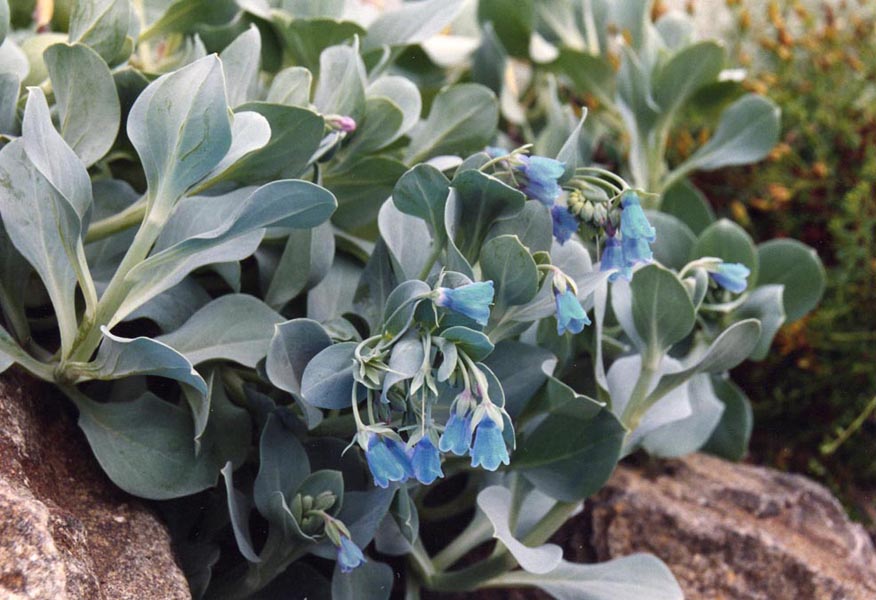
Mertensia maritima — Short-lived perennial of the Boraginaceae family, often behaving as a monocarpic in cultivation, native to the rocky shores and pebble beaches of the North Atlantic, found from the British and Irish coasts to Scandinavia, Iceland, and Greenland.
In its natural habitat, it colonizes coastal ridges, maritime cliffs, and coastal screes, in conditions of full wind, salty spray, and very well-drained substrates. It forms low, spreading clumps, rarely exceeding 15 cm in height, with prostrate or ascending stems. The foliage is particularly remarkable: the leaves, fleshy and glaucous, with a frosted blue-green hue, have a pronounced iodized flavor reminiscent of oyster, which gives it the English vernacular name of oyster plant or oyster leaf.
The flowers, small and tubular, open pink then turn sky blue at maturity, a common characteristic of the Boraginaceae. In its natural habitat, its flowering extends from May to July.
It is commonly offered in commerce under the name oyster plant, without its real requirements always being mentioned. Originating from shores battered by the cold northern winds, it poorly tolerates heat. It requires perfect drainage, poor and sandy soil, and a cool, well-ventilated exposure, preferably in partial shade.
Slugs are its main threat and attack its fleshy leaves with formidable efficiency; constant vigilance is essential.