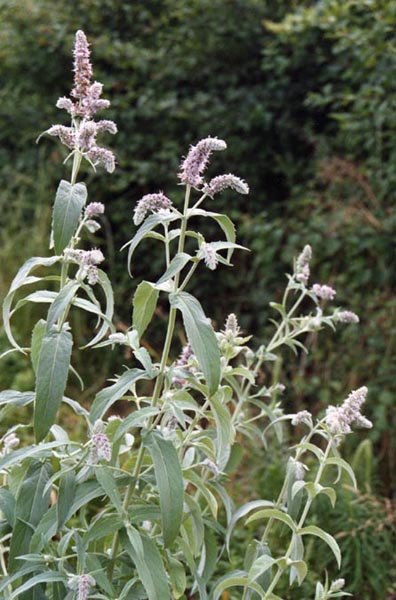
Perennial of the Lamiaceae family, the long-leaved mint is a native species in Europe, Western and Central Asia, and North Africa. It colonizes open wet environments, stream banks, ditches, marshy meadows, and shores, from sea level up to about 2,000 meters in altitude.
It forms vigorous and upright clumps of 40 to 100 cm, with robust quadrangular stems, spreading by stolons. Its most immediately striking feature is its silvery-grey foliage, densely tomentose on both sides, with elongated lanceolate leaves, sessile or nearly so, with toothed margins. This silvery down gives it a visual aspect quite distinct from all other native mints.
The flowers are pale pink to light lilac, grouped in cylindrical, dense, and elongated terminal spikes, clearly visible above the foliage. The whole plant exudes a strong but coarse menthol scent, not very pleasant for culinary use.
In its natural habitat, its flowering extends from July to September.
In cultivation, it requires a fresh to moist, rich soil, in full sun or partial shade. Vigorous and hardy, it can quickly colonize an area through its stolons. Its silvery foliage makes it a plant of banks or wet gardens with strong ornamental character, rarely exploited as such.