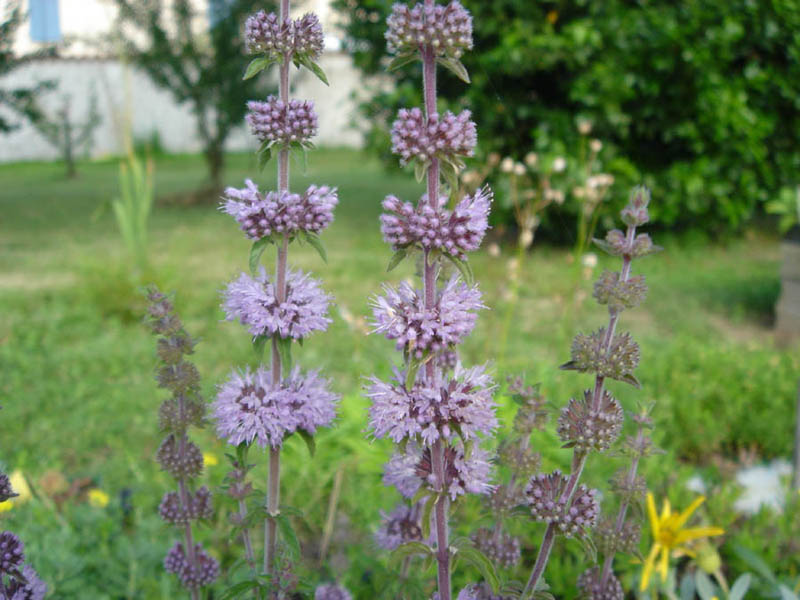
(photographed in the Landes)
(photographed in the Landes)
Perennial of the Lamiaceae family, the field mint is a species with a very wide distribution, present throughout Europe, temperate Asia, and North America. It frequents open and humid environments, roadsides, cultivated fields, fresh meadows, banks, and ditches, from sea level up to about 2,000 meters in altitude.
It forms upright clumps of 20 to 50 cm, with quadrangular stems characteristic of the Lamiaceae, often tinged with purple, and spreads by underground stolons. The leaves are oval-lanceolate, toothed, slightly hairy; when crushed, they release a pronounced but rather harsh menthol scent, less refined and less pleasant than that of Mentha x piperita.
The flowers, small, pink-lilac to pale lilac, are grouped in dense and well-spaced whorls along the stem, without a terminal spike — which distinctly sets it apart from peppermint and water mint. This regular arrangement of whorls on slender stems is one of its most recognizable features.
In its natural environment, its flowering extends from July to October.
Paradoxically, it is one of the least fragrant mints in use, but its very high content of raw menthol makes it the world's main source of industrial menthol, cultivated on a large scale, particularly in India. In cultivation, it prefers a fresh to moist, rich soil, in full sun or partial shade, and can become invasive through its stolons.