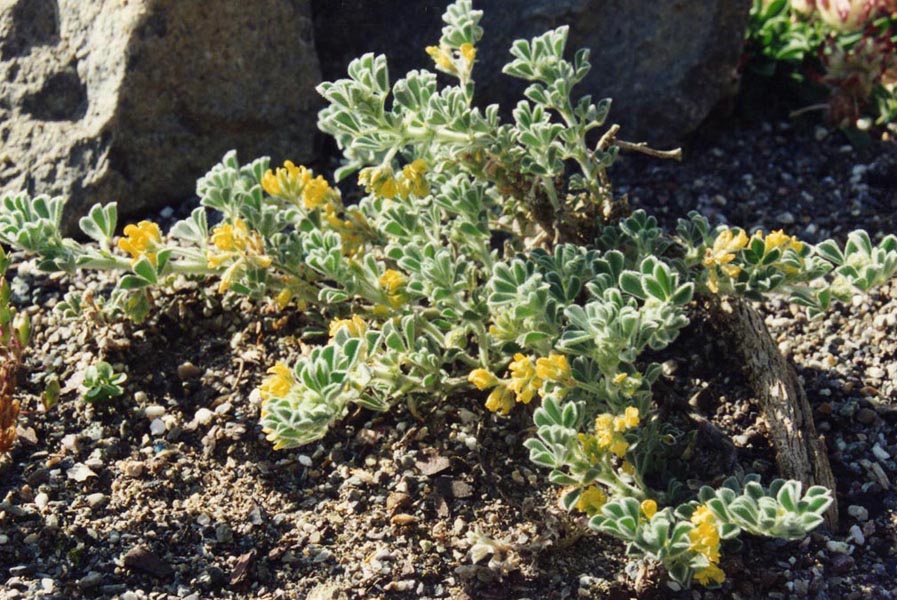
Perennial of the Fabaceae family, the sea alfalfa is a species of the Mediterranean and Atlantic coastlines, found from the coasts of Portugal to the Black Sea, as well as in North Africa. It exclusively colonizes mobile or semi-fixed coastal sands, white and grey dunes, fully exposed to the sun, wind, and sea spray.
It forms creeping and spreading clumps 8 to 15 cm in height, with woody stems at the base, densely branched. The entire plant is covered with a very thick white woolly tomentum, giving it a characteristic silvery-grey hue and constituting its main adaptation to dehydration and salt.
The leaves are trifoliate, with obovate leaflets and denticulate at the top, with a downy grey-white on both sides. The flowers, small and typically papilionaceous, are bright yellow and grouped in short, dense clusters that barely emerge from the foliage.
In its natural habitat, its flowering extends from April to June.
In cultivation, it requires a very well-drained, sandy or gravelly, poor soil, in full sun. It does not tolerate stagnant moisture or heavy soils. A plant for dry rock gardens or gravel gardens, it is hardy in regions with mild winters but remains sensitive to excess winter moisture.