Monocarpic perennial, sometimes biennial, of the Papaveraceae family, native to the high mountains of Central Asia, Tibet, Nepal, and southwest China, where it grows between 3,500 and 5,500 meters altitude, on scree, rocky slopes, and alpine meadows exposed to winds, in extreme conditions of cold and intense sunlight.
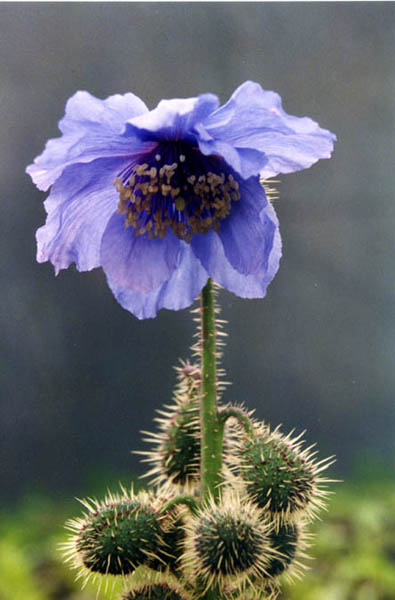
It forms a dense basal rosette of oblong leaves, entire or slightly lobed, entirely covered with stiff, golden spines that earn it its epithet — horridula meaning "bristly, somewhat horrible." This armor of prickly bristles is one of its most immediately recognizable traits.
The flowers, borne on sparsely branched stems of 20 to 40 cm, are lavender blue to bright blue, with four or five crumpled petals, with a contrasting brown-orange center of stamens. The hue varies according to populations and altitude.
In its natural habitat, its flowering extends from June to August depending on the altitude.
In cultivation, it is known to be difficult and capricious. It requires an acidic, very well-drained, poor soil, in full sun, and a cool climate with cold, dry winters. It dies after its single bloom and perpetuates by seeding. Its cultivation in lowland areas is rarely crowned with lasting success.