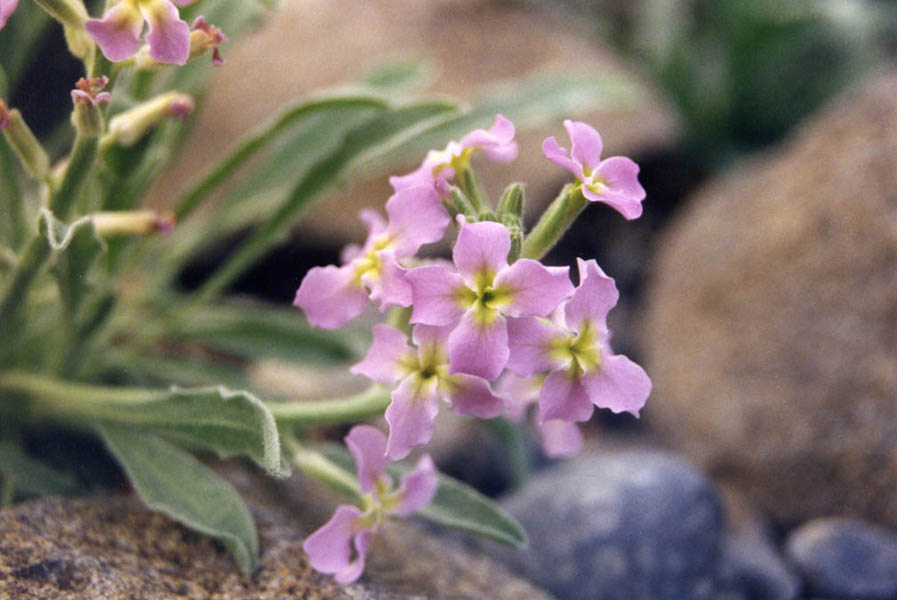
(Matthiola perennis, Matthiola scapifera)
(Matthiola perennis, Matthiola scapifera)
Perennial of the Brassicaceae family, this subspecies is confined to the Mediterranean coasts of the Iberian Peninsula and southern France, where it colonizes coastal sands, stabilized dunes, and dry, well-sunny sandy terrains, generally at low altitude. It is one of those rare plants capable of establishing itself permanently in a loose and poor sandy substrate, discreetly stabilizing the soil around it.
It forms spreading to semi-prostrate clumps, low-growing, reaching 15 to 35 cm in height, with slender, branched stems that spread out star-like from the base. The foliage is gray-green, finely tomentose, composed of narrow and lobed-cut leaves that harmonize with the minerality of the sandy substrate.
The flowers, with four typical Brassicaceae petals, are a soft lilac-pink with a pale yellowish center clearly visible, gathered in loose clusters at the end of the branches. In its natural habitat, its flowering extends from March to June depending on exposure and latitude. In cultivation, it can bloom as early as February-March in mild climates.
It imperatively requires a sandy or very well-drained soil, poor, in full sun, and poorly tolerates any prolonged moisture at the collar. Its hardiness is limited to mild winters, around -8°C at most. It is suitable for sandy rock gardens, coastal gravel gardens, and well-exposed containers.