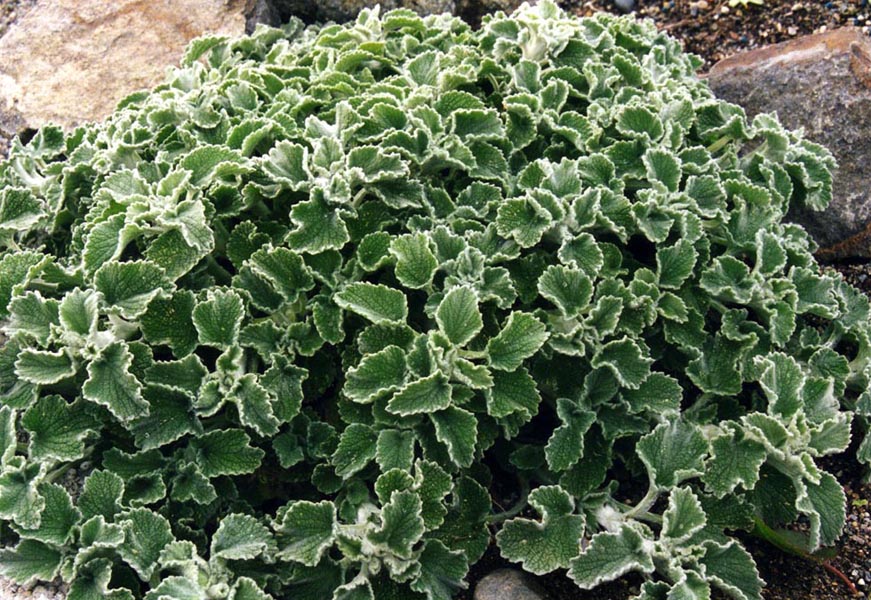
Perennial of the Lamiaceae family, native to the Mediterranean regions of the Balkan Peninsula and central and southern Italy, where it grows on dry rocky slopes, open garrigues, and sunny limestone screes, generally between 200 and 1,000 meters altitude.
It forms dense, rounded clumps, reaching 40 to 50 cm in height in bloom, but remaining much lower and compact outside of flowering. The foliage is its main asset in rock gardens: the leaves, oval-crenate, are covered with a very dense whitish to silvery felt, more pronounced on the edges and the underside, giving them a finely festooned appearance. The clump outside of flowering forms a green-gray cushion with pearly reflections, of remarkably ornamental texture.
The flowers, small and whitish, are grouped in tight, globular whorls arranged at regular intervals along the upright stems, forming a succession of characteristic pompons. In its natural habitat, its flowering extends from June to August. In cultivation, it generally occurs in June-July.
It requires full sun and very well-drained soil, preferably calcareous, poor and dry; it does not tolerate heavy and wet soils in winter. Hardy to about -15°C, it is perfectly suited to dry rock gardens and gravel gardens.