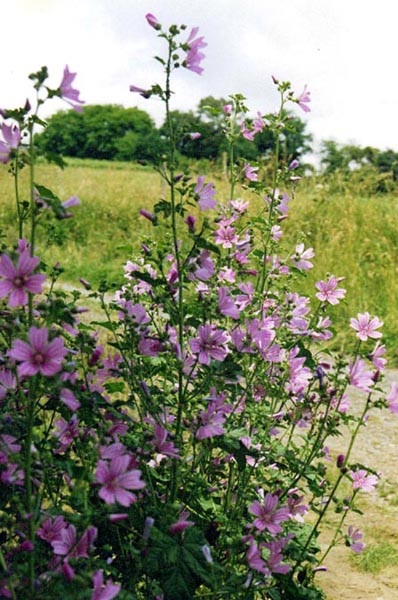
Perennial with often biennial behavior, from the Malvaceae family, present throughout Europe, temperate Asia, and North Africa. Naturalized on all continents, it is one of the most familiar weeds of sunken lanes, embankments, rubble, and ruderal wastelands, from sea level up to about 1,800 meters altitude.
It forms bushy clumps with erect or slightly spreading stems, reaching 60 to 120 cm in height. The leaves, long-petioled, are rounded, palmately lobed, a bright green and slightly hairy; they emit a slight musky odor when crushed.
The flowers, borne in the leaf axils on slender peduncles, display five pink-lilac to pink-violet petals, traversed by well-marked purple veins that give them a characteristic striped appearance. In its natural habitat, its flowering extends from June to September.
One of the oldest medicinal plants in Europe, it was cultivated in monastic gardens for its soothing properties; leaves and flowers were used in infusion against respiratory and digestive tract irritations. It grows without particular requirements, in any well-drained ordinary soil, in sun or partial shade, and reseeds abundantly.