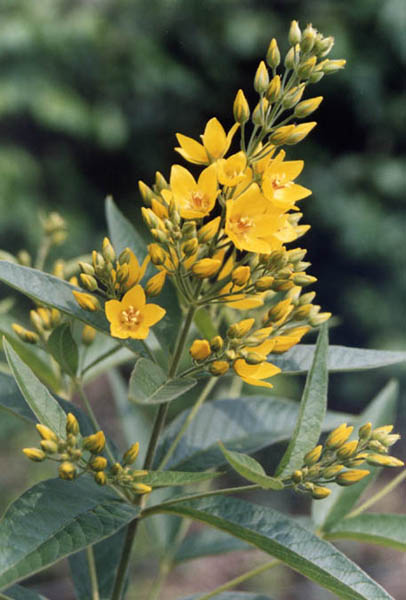
Robust perennial of the Primulaceae family, the common loosestrife is widely spread in Europe and temperate Asia. It colonizes the edges of watercourses, reed beds, marshes, floodplain meadows, and wet ditches, generally in plains and low mountains.
It forms large, upright, vigorous clumps, reaching 60 to 120 cm in height. The stems are upright, pubescent, bearing lanceolate to oval leaves, opposite or whorled in threes or fours, with a slightly downy matte green.
The flowers are a bright and warm yellow, with five slightly crumpled petals, gathered in well-branched terminal panicles that crown the stems with a certain generosity. A characteristic and easily observable detail is the orange or reddish margin of the petals, visible up close. In its natural habitat, its flowering extends from June to August. In cultivation, it blooms from June to July.
It was once believed to have the property of calming draft animals; its Latin name indeed evokes this ancient reputation as a soothing plant.
It requires fresh to moist soil, even temporarily flooded, in full sun or partial shade. Vigorous and colonizing through its rhizomes, it is suitable for large natural gardens, banks, and wet areas where it can spread freely.