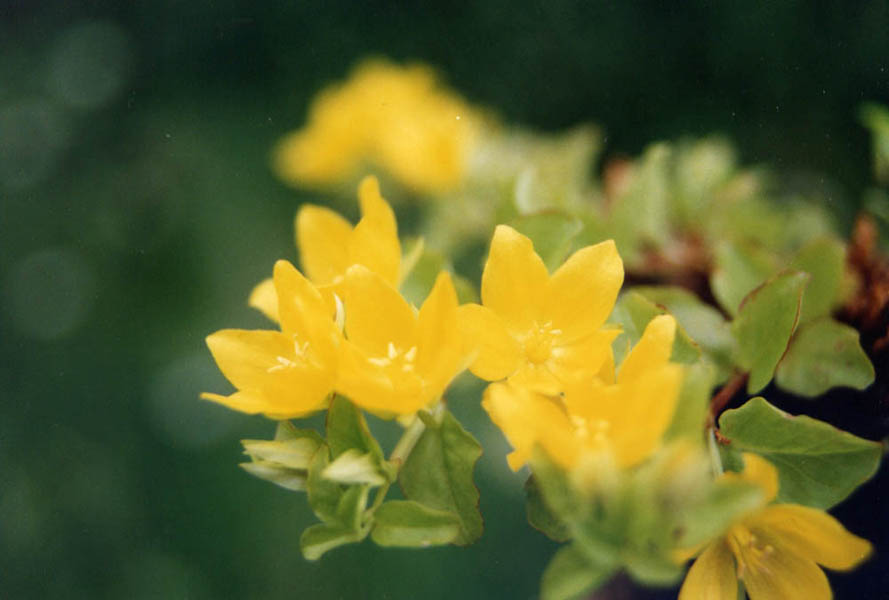
A perennial of the Primulaceae family, the moneywort is native to Europe, from France to western Russia, where it naturally colonizes stream banks, moist meadows, ditches, and cool undergrowth, from the plains to the mid-mountains.
It is strictly creeping, its threadlike stems can stretch from 30 to 60 cm without ever rising, rooting at the nodes upon contact with the ground and thus forming a dense and continuous carpet. The leaves are round to oval, opposite, a bright and shiny green, whose shape resembles small coins — hence the name nummularia, from the Latin nummulus, small coin — and the vernacular name herb of coins.
The flowers are bright yellow, widely open, star-shaped, solitary in the leaf axils, and produced abundantly along the entire length of the stems. In its natural habitat, its flowering extends from May to July. In cultivation, it generally blooms in June.
Formerly used in folk medicine as a vulnerary and astringent, it was applied to wounds and ulcers. It is cultivated in fresh to moist soil, in sun or shade, without particular requirements. Its vigor can make it invasive in conditions that suit it perfectly.