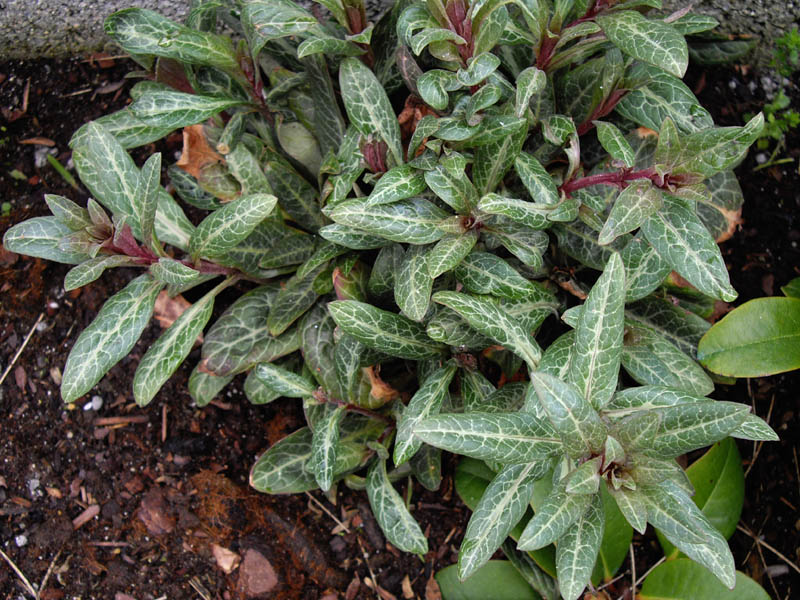
Perennial of the Primulaceae family, Lysimachia minoricensis is a species of exceptional rarity, endemic to the island of Minorca, in the Balearic Islands. It has been considered extinct in the wild for several decades and now only survives in a few specialized botanical collections, making it one of the most threatened plants in the western Mediterranean basin.
It forms an upright and bushy clump, reaching 20 to 35 cm in height, with prominently visible reddish stems. Its most striking feature is undoubtedly its foliage, with remarkable graphics, the lanceolate to elliptical leaves display a network of creamy white veins that contrast sharply against a dark green background, almost resembling a work of vegetal marquetry. This naturally variegated foliage is in itself the main interest of the plant aside from its flowering.
The flowers are small, white, discreet, borne at the axils of the upper leaves. In its natural habitat, its flowering extended from May to July.
In cultivation, it requires well-drained soil, fresh without excess winter moisture, in partial shade or filtered light. Its hardiness is moderate and it deserves protection in severe frost. Cultivating it is a modest contribution to the preservation of a species that nature no longer supports.