photographed in Spain
photographed in Spain
Poaceae. Perennial native to the western Mediterranean basin, found in Spain, Portugal, North Africa, and as far as arid Central Asia. In France, it is only present in a subspontaneous or introduced state in a few localities in the South. It colonizes salty or gypsiferous clay steppes, arid plains, and degraded lands subject to pronounced drought, always in plains or low altitudes.
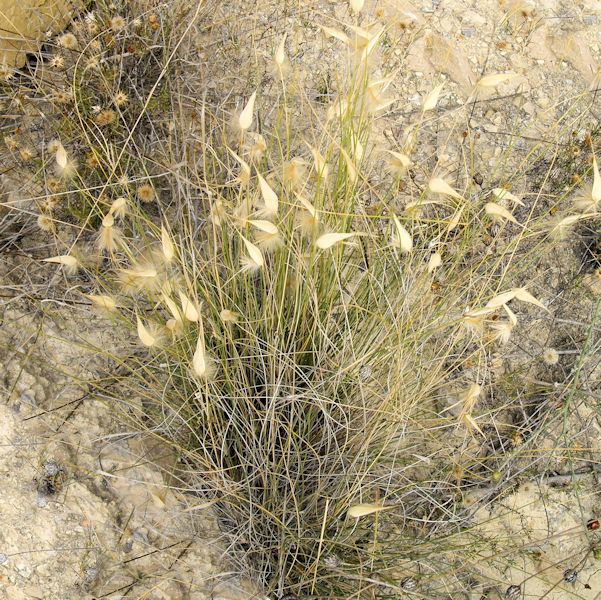
It forms dense and compact clumps of filiform leaves, glaucous to gray-green, leathery and rolled, 30 to 60 cm in height. This persistent foliage, highly resistant to desiccation, allows it to thrive on soils that few other grasses tolerate — compacted, saline, or gypsiferous substrates, almost devoid of organic matter.
The inflorescences are unusual for a grass: each stem bears a single spikelet enveloped in a large oval spathe, white to cream and membranous, reminiscent of a small flame or a veil billowed by the wind. At maturity, a long feathery and silky awn, silvery white, escapes from the spathe and quivers at the slightest breath — a particularly luminous effect in backlight. In its natural habitat, flowering extends from March to May, and the fruit-bearing stems persist for a long time, ornamental well after flowering.
Long harvested for the manufacture of mats, ropes, and quality paper in Spain and the Maghreb, this grass also plays a role in stabilizing degraded soils. In cultivation, it requires full sun and very well-drained, dry, and poor soil; it does not tolerate prolonged humidity.