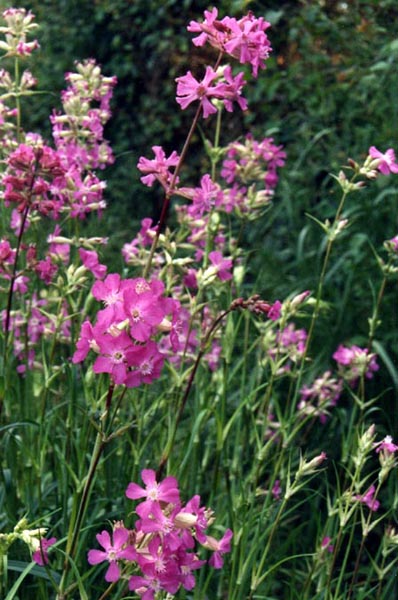
(Lychnis viscaria)
(Lychnis viscaria)
Caryophyllaceae. Indigenous perennial in Europe, from the Iberian Peninsula to Siberia, found in France mainly in mountainous massifs and on rocky outcrops of plains. It occupies dry grasslands, sunny siliceous rocks, moors, and open edges, on acidic, poor, and well-drained soils.
It forms upright and vigorous clumps of 30 to 60 cm, from a basal rosette of narrow, linear-lanceolate, dark glossy green leaves. The flowering stems are remarkable for their internodes coated with a sticky, viscous substance, brown to blackish, which traps small crawling insects — an adaptation that gives it its name and its popular nickname "catchfly". This natural glue notably prevents ants from reaching the nectar without ensuring pollination.
The flowers, a bright magenta pink to purple, are grouped in interrupted spiciform clusters, with several flowers grouped per node. The petals are slightly notched. In its natural habitat, its flowering extends from May to July. In cultivation, it blooms from April-May depending on the exposure.
It thrives in full sun on well-drained soil, dry to fresh, preferably acidic or neutral. Robust and undemanding, it is suitable for rock gardens, sunny embankments, and flower meadows on light substrates.