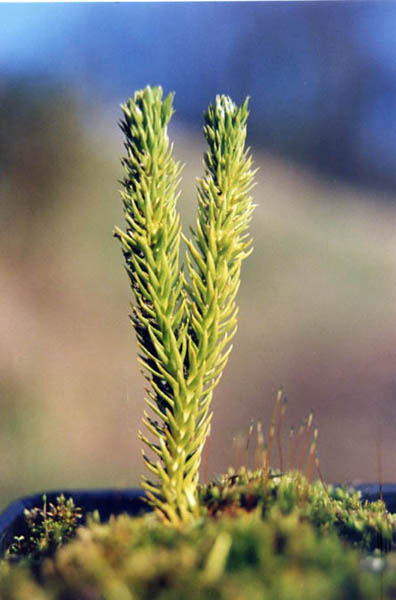
syn. Lycopodium selago
syn. Lycopodium selago
Lycopodiaceae. Vascular plant without flowers or seeds, reproducing by spores, classified among the lycophytes — a group of remarkable antiquity, having appeared more than 400 million years ago. Circumpolar, it is present throughout mountainous Europe, in Asia, North America, and even in arctic regions. In France, it is found in the Alps, the Pyrenees, the Massif Central, and the Vosges, between 1,000 and 3,000 meters, on wet rocks, peaty moors, mossy screes, and snow hollows, always on acidic substrates.
It forms small, upright, and rigid tufts, from 5 to 20 cm, with densely leaved stems, branching dichotomously — each stem regularly divides into two equal forks, a clearly visible characteristic. The leaves are small, lanceolate, bright green to yellowish-green, arranged in a tight spiral along the entire length of the stems, giving them the appearance of a miniature conifer or small yew.
It does not form distinct sporiferous spikes like other clubmosses; the sporangia are directly inserted at the axil of ordinary leaves, distributed along the stems. In some places, small vegetative bulbils develop between the leaves, ensuring clonal multiplication.
A collector's plant, it is very difficult to cultivate, requiring constant atmospheric humidity, an acidic, peaty, and drained substrate, a cool and bright exposure without direct sunlight. Its growth is extremely slow.