Caryophyllaceae. Perennial native to the southern Alps, found in the mountain ranges of France, Switzerland, Italy, and Austria. It grows on rocky grasslands, stabilized scree, sunny slopes, and dry edges, generally between 1,000 and 2,500 meters, on well-drained, often calcareous substrates.
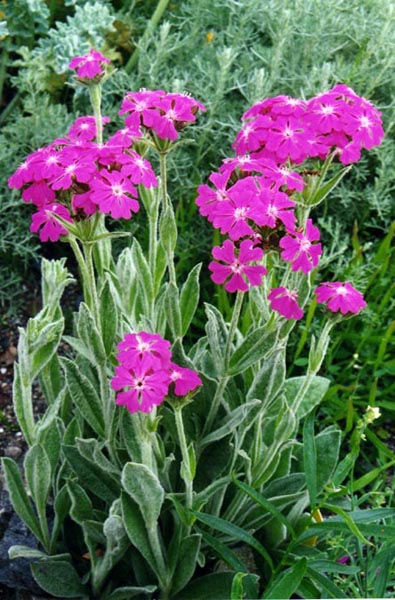
The plant forms a compact basal clump of oval-lanceolate leaves, entirely covered with a dense white-silver tomentum, giving them a woolly and soft texture. The flowering stems rise to 30–40 cm, also gray and downy, bearing narrower and opposite cauline leaves.
The flowers are grouped in fairly dense terminal corymbs, in a magenta pink to bright purple, with slightly notched petals and a well-marked central white eye. The combination of silver foliage and intensely pink flowers visually resembles Lychnis coronaria, but it is distinguished by its more compact habit, less branched stems, and strictly alpine origin. In its natural habitat, its flowering extends from June to August depending on the altitude. In cultivation, it generally blooms in May-July.
It requires full sun and well-drained, light, moderately poor soil. Perfectly suited to rock gardens, walls, and gravel gardens, it tolerates drought well once established but does not tolerate stagnant winter moisture.