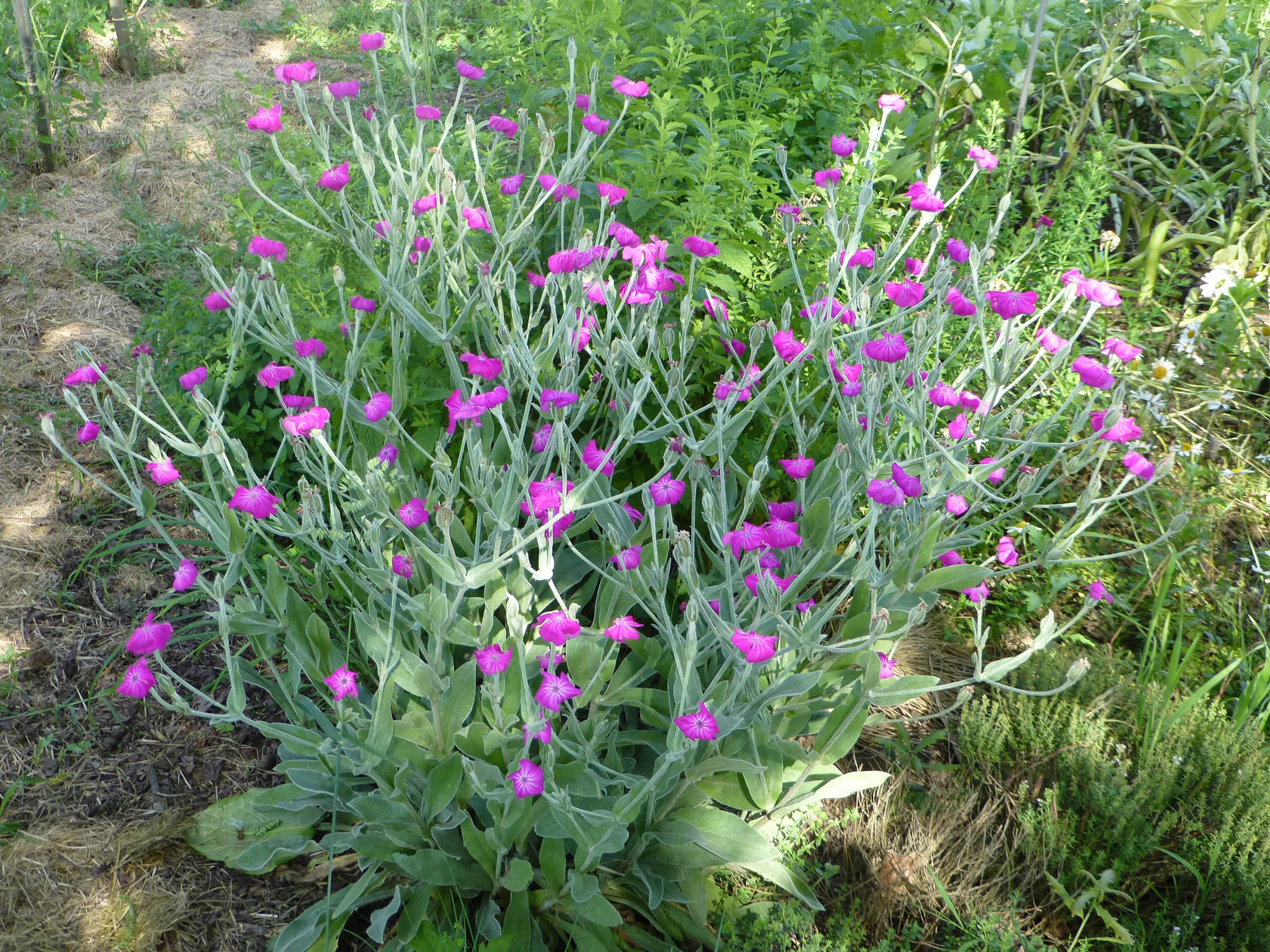
Caryophyllaceae. Short-lived perennial, often behaving as a biennial, native to southeastern Europe and Asia Minor. It naturally occupies rocky wastelands, dry banks, open garrigues, and roadsides on poor, well-drained, calcareous or siliceous soils, in full sun exposure.
It develops a basal rosette of large oval leaves, with a very characteristic velvety silver-gray, covered with a dense tomentum that gives them a woolly texture to the touch. The flowering stems, also gray and downy, rise to 50–80 cm, branching widely, forming a bushy and airy silhouette that strikingly contrasts with the surrounding vegetation even before the flowers open.
The flowers, solitary at the top of each branch, are a bright magenta pink to vivid purple of an almost garish intensity — a bold chromatic combination with the silvery foliage that has made this species renowned in dry gardens. In its natural habitat, its flowering extends from June to August. In cultivation, it generally blooms from May to July.
It self-seeds abundantly and spontaneously, thus ensuring its longevity in the garden despite its short individual life. It requires full sun and very well-drained soil, perfectly tolerates summer drought and heat, but quickly perishes in heavy or constantly moist soil.