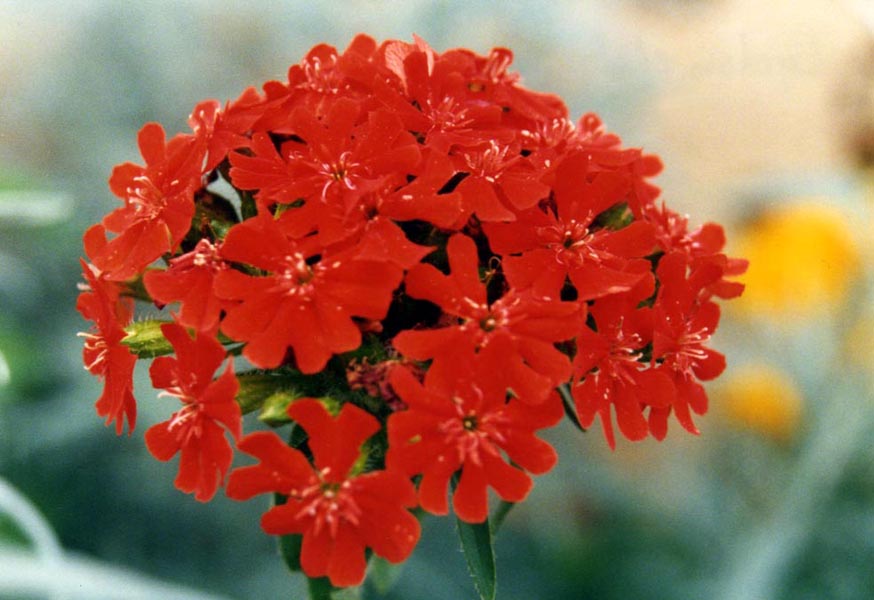
Caryophyllaceae. Perennial native to western Russia and central Asia, introduced to Europe as early as the Middle Ages, probably brought back from the Crusades — hence its popular name "Jerusalem cross," in reference to the cross shape characteristic of each of its bifid petals. It naturally grows in wet meadows, forest edges, and riverbanks.
The plant is upright and robust, reaching 60 to 90 cm in height. The stems are rigid, slightly hairy, bearing oval to lanceolate, opposite leaves, medium green, sessile, and slightly clasping.
The flowers are of a scarlet red of remarkable intensity, gathered in dense, rounded corymbs at the top of the stems. Each flower has five deeply notched petals, forming a ten-pointed star clearly visible up close. This pure red color, without orange or pink hues, is one of the most vivid found in garden perennials. In its natural habitat, its flowering extends from June to August. In cultivation, it generally blooms in June-July.
It requires fresh, moderately rich, well-drained soil, in full sun to partial shade. The clumps benefit from being divided every three or four years to maintain their vigor.