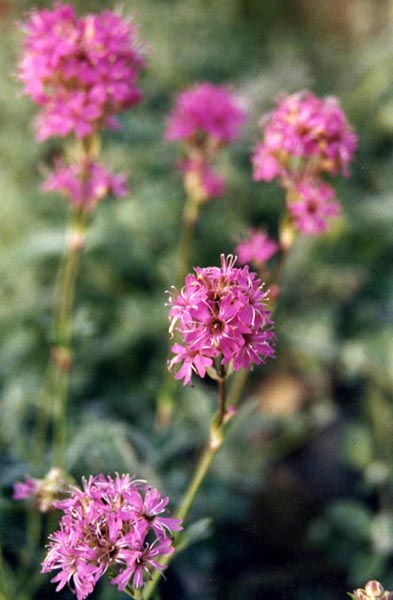
(Lychnis alpina)
(Lychnis alpina)
Caryophyllaceae. Circumpolar perennial of the arctic and alpine regions of Europe, found in the Alps, the Pyrenees, the Scandinavian mountains, and the arctic areas of Eurasia and North America. It grows on windy ridges, stabilized scree, short alpine grasslands, and siliceous rocks, generally between 1,800 and 3,000 meters, on poor, well-drained, and acidic soils.
The plant forms small, dense, low tufts, rarely exceeding 5 to 15 cm in height. The basal leaves are narrow, linear, dark glossy green, grouped in compact rosettes that persist in winter. The flowering stems are slender and upright, bearing a few pairs of reduced leaves.
The flowers, gathered in tight, rounded terminal glomerules, are bright pink to intense magenta pink, with deeply bifid petals — a typical characteristic of lychnis. This floral compactness on such short stems gives it an almost miniature appearance but with great color intensity. In its natural habitat, its flowering extends from June to August depending on altitude. In cultivation, it generally blooms in May-June.
It requires a very well-drained, lean soil, preferably acidic to neutral, in full exposure. A choice plant for the alpine rockery or gravel gardens, it withstands cold perfectly but dreads stagnant moisture in winter.