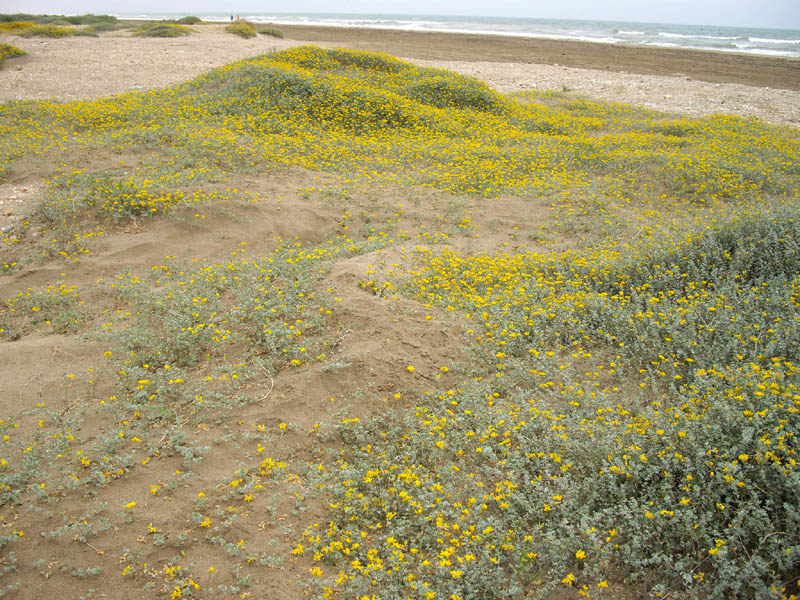
photographed in Spain
photographed in Spain
Fabaceae. A subshrubby perennial, sometimes treated as suffrutescent, native to the broader Mediterranean region, from the Iberian Peninsula to the Near East, including the Maghreb, Crete, and the Greek islands that gave it its name. It is characteristic of coastal dunes, littoral sands, and open garrigues on very well-drained sandy or stony substrates, always in full light.
It is a creeping to spreading plant, forming dense and continuous mats 20 to 40 cm high, capable of covering large areas. Its most immediately striking feature is its foliage entirely covered with a dense silvery tomentum, giving the whole plant a very bright silver-gray color, sharply contrasting with the bright yellow of the flowers. The leaflets, five in number, are small and narrow, closely set along the stems.
The papilionaceous flowers, of an intense and uniform golden yellow, are grouped in umbels of 3 to 6, borne on slender peduncles that emerge from the silvery foliage. In its natural habitat, its flowering extends from April to June, sometimes until July depending on the location. In cultivation under mild climates, it can bloom as early as March.
It requires full sun and a very well-drained soil, preferably sandy, and is quite drought-tolerant in summer. Not very hardy in cold and wet winters, it is best reserved for Mediterranean gardens, very exposed rockeries, or to be grown in containers under shelter in regions with severe frosts.