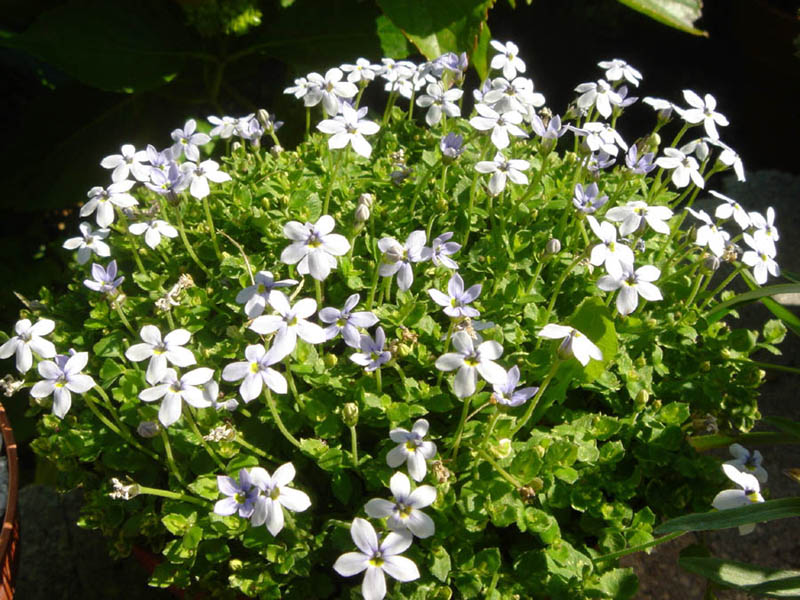
Perennial of the Campanulaceae family, Lobelia pedunculata is native to Australia and New Zealand, where it grows in wet meadows, stream edges, and peat areas at moderate altitude. It is sometimes marketed under the synonym Pratia pedunculata, a name no longer retained today.
It forms a very dense creeping mat, spreading by stolons over a wide area, with a flowering height of only 5 to 8 cm. The leaves are small, oval to slightly toothed, bright and shiny green, arranged very tightly along the stoloniferous stems. The tuft in full bloom takes on the appearance of a rounded and homogeneous cushion, literally covered with flowers.
The flowers, borne on thin peduncles well visible above the foliage, have five spreading lobes of a white slightly tinged with pale lavender blue, with a discreet yellow-green center and fine bluish streaks. It is this lavender hue, variable depending on sunlight and individuals, that immediately distinguishes the species from Lobelia angulata with frankly white flowers. In its natural habitat, its flowering extends from spring to the austral summer. In cultivation under a temperate climate, it blooms abundantly from May to July, sometimes until September.
It requires a fresh to moist soil, well supplied with humus, in partial shade or moderate sun. It is suitable for damp paving joints, water feature borders, and cool rock gardens. Its hardiness is correct up to about -10 °C, but it dreads winters that are both cold and dry.