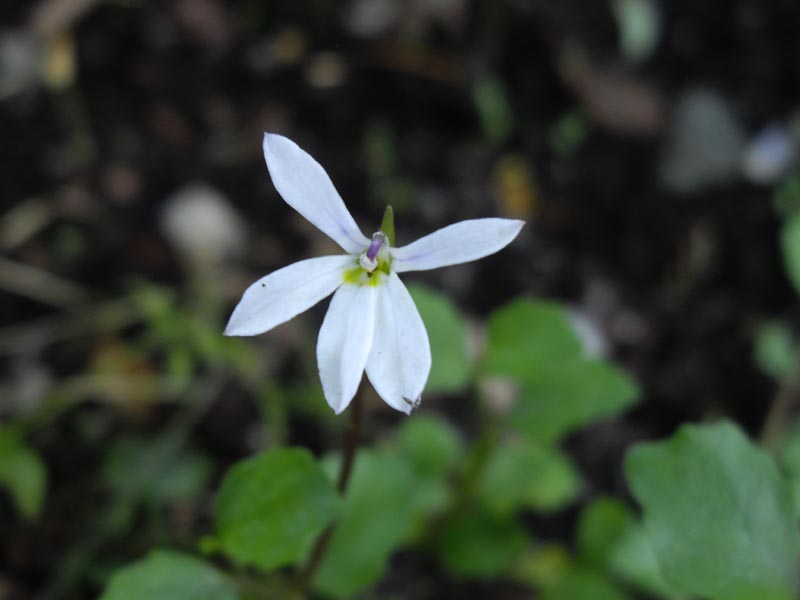
Perennial of the Campanulaceae family, Lobelia angulata is native to New Zealand and Australia, where it occupies wet meadows, stream banks, and marshy areas at moderate altitude. It is sometimes marketed under the name Pratia angulata, a synonym now not retained by Kew.
It is a creeping and sprawling plant, barely exceeding 3 to 5 cm in height, gradually spreading by stolons to form a dense and regular carpet. The leaves are small, rounded to slightly toothed, medium green to slightly yellowish, borne on short petioles. Their soft texture and tight arrangement give the carpet an almost mossy appearance.
The flowers, solitary on slender erect peduncles, exhibit the bilabiate structure characteristic of lobelias, with two narrow upper lobes and three wider lower lobes, all pure white with a yellow-green eye in the center and slight purple streaks on the lower lobes. In its natural habitat, its flowering extends from spring to summer. In cultivation under temperate climates, it blooms from May to July, with sometimes an autumn resurgence.
It requires soil that is constantly fresh to moist, rich in humus, in partial shade or filtered light. Excellent for covering the ground between wet stones, at the edge of a water feature, or in the gaps of a shaded paving. It withstands moderate frosts but fears prolonged cold and dry winters.