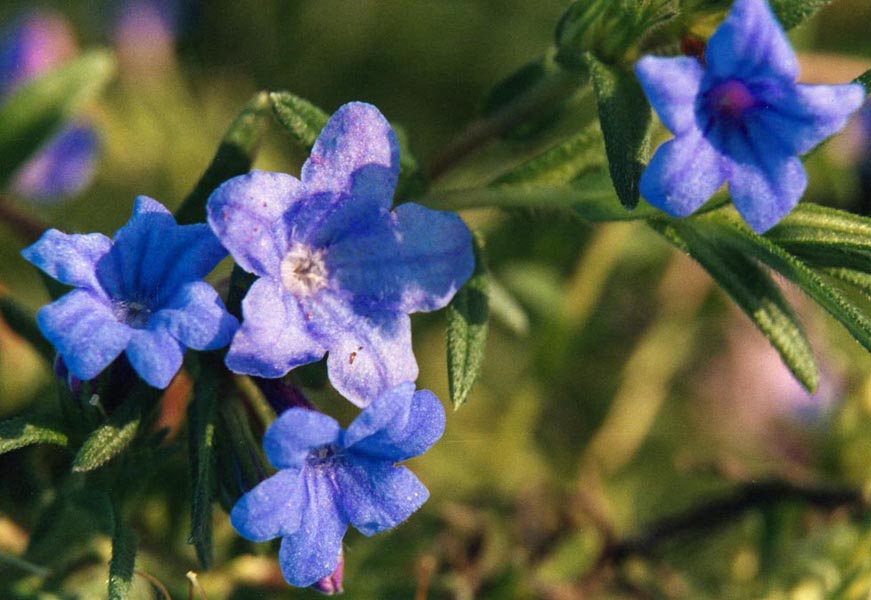
syn. Lithodora diffusa
syn. Lithodora diffusa
Perennial sub-shrub of the Boraginaceae family, Glandora diffusa is native to the Iberian Peninsula and the Atlantic and Mediterranean regions of Western Europe. In its natural habitat, it colonizes open heaths, low garrigues, the edges of light forests, and sunny rocky areas, on acidic or siliceous substrates, from the collinean level up to about 1,200 meters.
It forms a dense and prostrate mat, rarely more than 15 cm in height, with woody stems at the base covered with small, narrow, evergreen leaves of a dark green color, with a slightly rough and ciliated surface. This tight and matte foliage provides a sober background that highlights the intensity of the flowering.
The tubular flowers, with five spreading lobes, are of a bright and deep blue, characteristic of the wild type, generally more intense and sustained than that observed in most garden cultivars. In its natural habitat, its flowering extends from March to June depending on altitude and exposure. In cultivation, it can begin as early as the end of March and extend until July.
It imperatively requires an acidic, well-drained, poor soil, in full exposure. It does not tolerate either limestone or excess moisture in winter. A light pruning after flowering maintains a compact habit.